
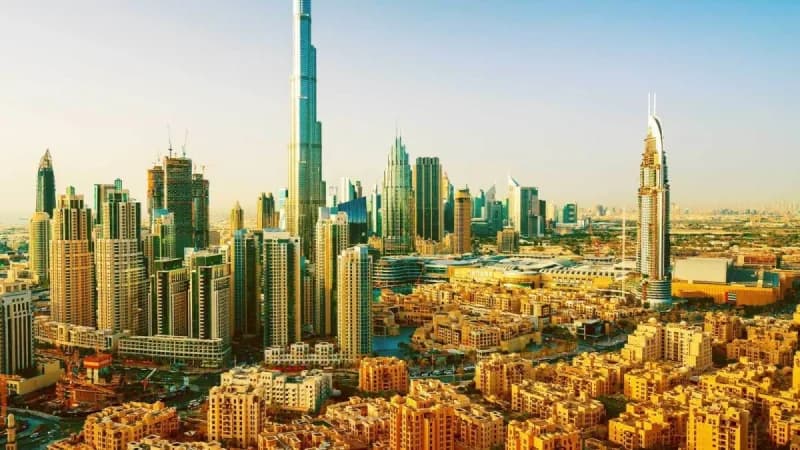
At the session titled 'The UAE: A Safe Haven and a Winning Investment', held as part of the Emirates Media Forum, Hamed bin Karam, Editor-in-Chief of Al Bayan, posed a question that seemed simple on the surface but ran deep in its implications: if gold is safety, and Dubai is known as the City of Gold, is Dubai today the embodiment of safety itself?
The question was not merely about the metal, but about what it means to be a haven in turbulent times. People do not love gold because it gleams — they love it because it endures. They return to it not as an ornament, but because it preserves value when markets falter, currencies wobble, and options narrow. From this vantage point, the question about Dubai becomes a question about trust: has the city transformed from a market for gold into the gold of cities?
Gold is a silent asset. It does not raise a tower, open a company, give your children a school, or connect you to the world via an airport. Dubai, by contrast, is a living, breathing haven — safety with streets, laws, ports, airports, free zones, waterfronts, markets, banks, and a complete life. Gold protects wealth from the outside; Dubai gives wealth an environment in which to work.
This is why 'City of Gold' is no longer merely a commercial label. It has become an economic metaphor. Dubai does not tell the investor: hide your money here. It says: put your money to work here. Buy, build, establish, expand, experiment, launch. There is a vast difference between a haven that freezes fear and a city that converts fear into a decision.
The numbers help illuminate this meaning. According to the Dubai Department of Economy and Tourism, Dubai ranked first globally in new foreign direct investment projects in 2024 for the fourth consecutive year, attracting 52.3 billion dirhams — approximately 14.2 billion dollars — a growth of 33.2% over the previous year. This figure does not merely say that investors like Dubai; it says they trust it at a moment in global affairs when trust is not easily granted.
In real estate — the mirror in which a city's appetite and the public's confidence are most clearly reflected — Dubai's market recorded more than 270,000 property transactions in 2025, with a total value exceeding 917 billion dirhams, according to official data from the Dubai government. This is not passing speculative activity so much as a long-term vote of confidence in a city that many see as simultaneously liveable, workable, and investable. A home in Dubai is not merely four walls; it is a residency decision, a temporary or permanent sense of belonging, and perhaps a fresh start.
Yet safety cannot be measured by investment alone. Safety begins with the simple feeling: being able to walk freely, work, open a business, let your children go to school, and know that the law is present — that order is not a luxury but an everyday foundation. This is what gives safety rankings their meaning. In the Numbeo Safety Index for 2025, the United Arab Emirates topped the list of the world's safest countries with a score of 85.2, as reported by Gulf News. Numbers alone are never sufficient, but they explain why Dubai appears to many of those who come to it not merely as a city for profit, but as a city for peace of mind.
Then comes the real gold — the gold of commerce. According to reports on the Dubai Multi Commodities Centre, gold worth 129 billion dollars passed through Dubai in 2024, a 36% increase over the previous year. At the Dubai Gold and Commodities Exchange, the value of the Sharia-compliant spot gold contract rose from 15.6 million dollars in the first half of 2024 to 46.8 million dollars in the first half of 2025, an increase of nearly 200%. These figures say that Dubai does not borrow the title of gold from poetry — it borrows it from the market.
And yet, the story is not a story about a metal. Gold, in the end, has no vision. Dubai was built on one. Gold does not innovate; Dubai does. Gold does not bet on people; Dubai has made the investor, the resident, the tourist, and the entrepreneur all part of its economy. Gold does not speak; Dubai speaks the languages of the world, receives the world, and sells the world an idea that may be worth more than any metal: that the future can be safe, if it is properly managed.
From here, one can understand Al Abbar's words in a broader sense. When he says that gold is safety, he does not mean that all safety lies in bullion. He reminds us that human beings, however far they progress, ultimately search for something they can trust. Gold was once one of those things. Today, in a turbulent region and an unstable world, cities themselves are being tested as metals are tested: which ones hold? Which ones preserve value? Which ones do not lose their lustre when circumstances change?
Dubai is not gold because it gleams. Much that gleams eventually fades. Dubai is closer to gold because it has made trust an economic asset — because it has turned security into a business environment, stability into opportunity, law into an investment framework, and ambition into a daily habit. And because, like gold, it does not need to explain its value at length; it is enough to see who comes to it when they are searching for a beginning, a haven, or safety.
Perhaps the most beautiful question is not: is Dubai the City of Gold? But rather: has Dubai become the gold of cities?
In the investor's answer, yes. In the resident's answer, yes. And in the answer of those who see cities not as maps but as shelters of trust, Dubai appears to be more than a city of gold. It appears to be a city that tells the world: safety is not hiding what you own — it is finding a place that makes you want to build more.