
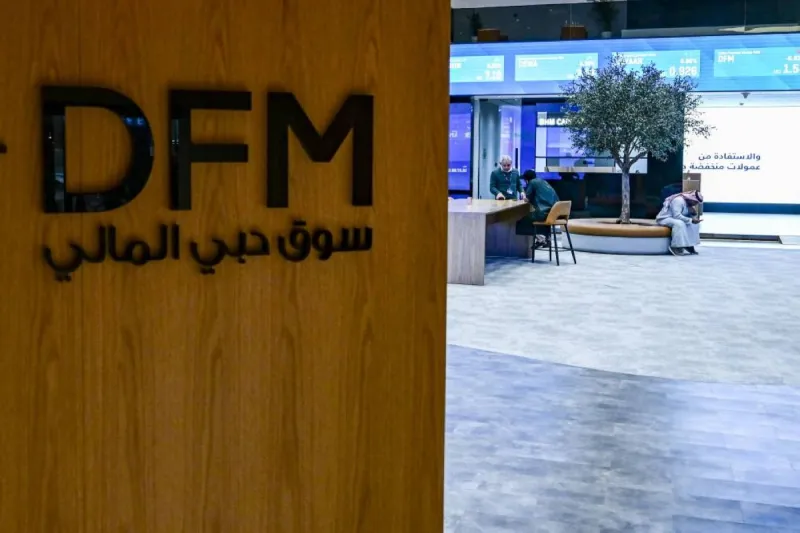
Attention in the Dubai Financial Market and Abu Dhabi Securities Exchange is focused on new support levels driving index gains, backed by leading stocks in the real estate and financial sectors, amid a strong return in foreign investment appetite.
The Dubai Financial Market index jumped 2.2% since the start of the year, after surging 3.5% last week to close above the 6,160-point level. The Abu Dhabi Securities Exchange index ended last week up 2.2%, closing at 10,017 points, recording a gain of 0.2% since the beginning of the year.
The equity markets registered combined market gains of nearly 117 billion dirhams, distributed as 74.4 billion dirhams for the Abu Dhabi Securities Exchange and approximately 42.5 billion dirhams for the Dubai Financial Market. The strong performance was driven by broad gains in the real estate, banking, and industrial sectors, alongside continued buying momentum from foreign investors, who recorded net purchases exceeding 1 billion dirhams — 288 million dirhams in Abu Dhabi and 737.2 million dirhams in Dubai.
Real estate leads the way
In the Dubai Financial Market, the real estate sector topped the list of rising sectors after its index climbed 8%, followed by the consumer staples sector at 5%, then the industrial sector at 3.7%, the financial sector at 2.9%, and the utilities sector at 2.8%.
In contrast, the telecommunications sector index fell 1.7%, the consumer services sector index declined 1.4%, while the basic materials sector index remained unchanged.
In the Abu Dhabi Securities Exchange, the real estate sector index led gains with a rise of 13.8%, followed by the utilities sector index at 12%, then the healthcare sector index at approximately 4%, followed by the technology, telecommunications, and consumer staples sector indices at more than 3%.
The industrial sector index rose 2.7%, followed by the financial sector index at 1.5%, then the consumer discretionary sector index at 1.2%. In contrast, the energy sector index fell 0.3%, followed by the basic materials sector index with a slight decline of 0.05%.
Support levels
In the Dubai Financial Market, the 6,160-point level is considered an important technical level that had previously represented a key resistance level; maintaining it reinforces the continuation of the upward trend, while secondary support levels are indicated at 6,050 points.
Target resistance levels for the coming period stand at 6,250 points, 6,350 points, and 6,500 points as a medium-term target.
In the Abu Dhabi Securities Exchange, the breach of the 10,000-point level represents an important technical event, turning 10,000 points into a key psychological support, with 9,900 points as short-term technical support and 9,750 points as medium-term support.
If positive momentum continues, the index may target 10,150 points, 10,300 points, and 10,500 points in the medium term.
For investors, a strategy of gradual entry on pullbacks appears most appropriate, rather than heavy buying after strong rallies. This was observed last week, when UAE equity markets extended gains for a second consecutive week, supported by improved investor appetite and higher market sentiment, coinciding with the signing of the US-Iran agreement, which bolstered market confidence and supported liquidity flows and foreign buying.
The Dubai Financial Market index closing above 6,160 points confirms the continuation of the upward trend, increases the probability of targeting new levels in the second half, and reflects the return of investor appetite, particularly among foreign institutions.
The Abu Dhabi market's hold of the 10,000-point level carries significant technical and psychological weight, confirming improved investment confidence and reinforcing the likelihood of a larger return of institutional liquidity.
It can be said that the markets have already entered a medium-term upward phase, with the potential to evolve into a long-term rally if supported by upcoming financial results.
Promising sectors
As the end of the first half and the start of the third quarter approach, several sectors stand out as candidates for continued positive performance. Leading these is the real estate sector, which remains the most attractive, supported by sustained domestic and international property demand, growth in off-plan sales, rising population and resident numbers, strong foreign investment flows, and the continued launch of new projects. Leading stocks in the sector remain candidates to benefit from the continuation of the current real estate cycle.
The banking sector also stands out, with banks positioned to deliver strong results in the second half, supported by lending growth, higher fees and non-financing revenues, high asset quality, and strong capitalisation and liquidity levels. The sector is expected to maintain attractive cash distributions for investors.
The utilities and energy sector also remains among the most prominent, offering stable cash flows, high dividend yields, and lower volatility compared to other sectors, with conditions in the energy sector normalising, making it suitable for investors seeking defensive returns.
As for the industrial and logistics sector, it continues to affirm its position, with ongoing government spending and expansion in industrial and commercial activities expected to sustain solid performance among industrial and logistics companies.
Outlook for the new week
Expectations point to markets entering the new week in a phase of testing the recent breakout levels. The positive scenario is considered the more likely one, with Dubai maintaining trading above 6,150 points and Abu Dhabi remaining above 10,000 points, amid continued momentum in the real estate and banking sectors.
In this case, the Dubai market may target a range of 6,250–6,300 points, while Abu Dhabi is expected to reach 10,150–10,300 points.
Markets may also see short-term profit-taking following the recent strong gains, particularly in real estate stocks. However, any pullbacks towards key support levels could present opportunities for investors to rebuild their investment positions.