
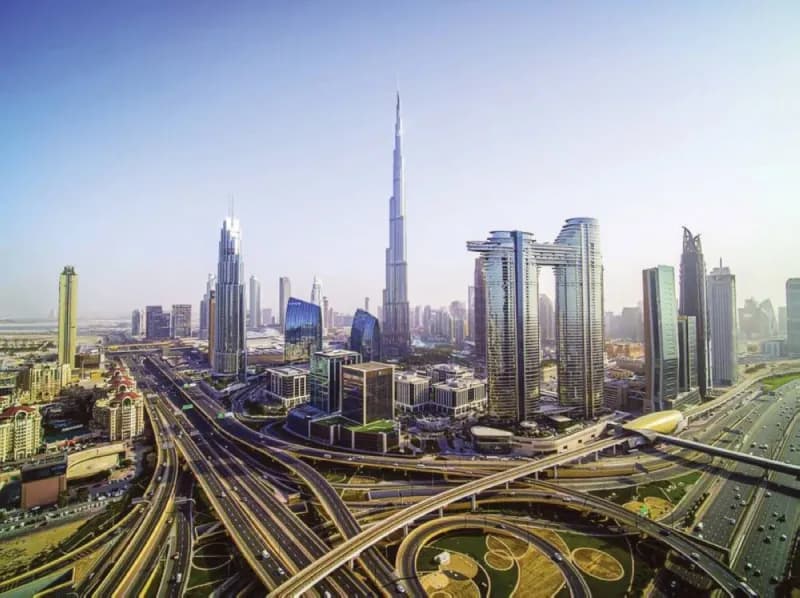
The secret to Dubai's road network success and superiority does not rest solely on its status as a leading tourist destination and influencer hub, its emergence as a global financial centre, or its headline-grabbing architectural achievements. There is a more fundamental golden factor underpinning the city's thriving standing: its roads and infrastructure, according to a report by AD Middle East magazine.
The report noted that in recent years Dubai has continued its steady climb in global road network rankings. A 2024 World Economic Forum report placed the United Arab Emirates fifth internationally, and by 2025 a separate ranking published by Daily Jang placed the country fourth in the world. The same ranking also placed the UAE at the top of the Arab region.
The magazine pointed out that the reasons behind this achievement are numerous, but they cannot be separated from the Middle East's position in the oil industry. One of the key elements that elevates the quality of Dubai's roads above others is the use of materials derived from oil by-products — specifically bitumen extracted from petroleum refining, also known as asphalt.
Road construction companies in Dubai use high-quality polymer-modified asphalt that provides enhanced durability. This component is mixed with locally sourced limestone aggregate to produce a surface that maintains its cohesion and integrity even at temperatures exceeding 50 degrees Celsius.
Put simply, Dubai's highways are built to last. A set of sophisticated engineering methods ensures that Dubai's roads can withstand the city's heavy commercial traffic regardless of the heat, as they are constructed with multi-layered foundation systems.
These include crushed-stone base layers, cement-stabilised sub-base layers, and geotextile fabric supports.
These reinforcements maximise load-bearing capacity and ensure long-term structural stability. This strategy has delivered a road performance rating of 96.95%, supporting the United Arab Emirates' goals of enhancing quality of life and providing sustainable, long-term transport.
Naturally, this performance is the result of sustained investment in infrastructure. Dubai's transformation into a modern city began in the 1960s with the construction of its first major highway, Sheikh Zayed Road, which was completed during the 1970s and 1980s and remains to this day a symbol of the remarkable progress the city has achieved.
Over the past decade, more than 13 billion dirhams (AED) have been invested in infrastructure, and Dubai today boasts more than 4,500 kilometres of highways — a figure that continues to rise.
New roads are currently being built with 35% recycled materials, with plans to raise that proportion to 50% by 2027. This year, all new highway lighting systems are scheduled to run on solar power, making them 100% reliant on renewable energy.