
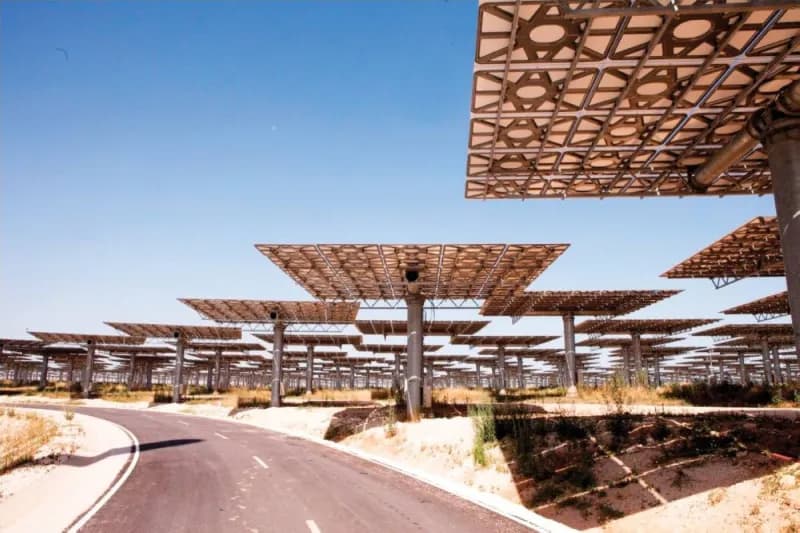
The UAE and the Gulf Cooperation Council states are increasing investment in renewable energy as part of broader efforts to decarbonise their economies, diversify revenue sources, and preserve hydrocarbons for export, with the UAE having firmly established itself as a global destination for green energy investment.
According to S&P Global Ratings, the UAE plans to triple its combined clean energy capacity and has committed to net-zero emissions by 2050.
Rated renewable energy projects in the region have continued to operate normally, confirming a key distinction from fossil-fuel-based systems: large-scale solar photovoltaic projects in the Gulf states remain broadly insulated from commodity price volatility.
These large-scale projects benefit from highly automated operations, limited on-site workforces, and reliance on locally sourced spare parts, factors that collectively reduce exposure to supply chain disruptions and support operational resilience in the absence of physical damage.
The Gulf Cooperation Council states are particularly well positioned to expand solar and wind deployment, supported by abundant solar resources, extremely low photovoltaic energy costs, large expanses of available land, and increasingly complementary wind characteristics. Government facilitation and licensing have underpinned rapid renewable energy capacity construction across the region in recent years.
Nevertheless, this expansion reveals structural challenges at the grid level. Solar and wind generation are intermittent by nature, while electricity demand in the region remains structurally high throughout the day — driven by cooling needs — and frequently extends into the evening when solar output declines, creating a persistent supply-demand mismatch that pressures grid stability.
As these dynamics intensify, battery storage is set to play an increasingly central role in the region. Storage enables renewable energy to deliver stable, dispatchable power and supports grid reliability as renewable penetration rises. In the Gulf states, long-term, fixed-price power purchase agreements with highly rated counterparties guarantee stable and predictable revenues, effectively insulating projects from short-term market fluctuations and curtailment risks, which are typically borne by the buyer.
Furthermore, robust and supportive contractual frameworks in the Gulf states provide additional protection against geopolitical risk events.
The Gulf states host some of the world's largest battery tenders, with the UAE leading large-scale deployments. The UAE is advancing one of the world's largest solar-plus-storage projects, expected to enter service in 2027.
Government participation has been key: government-linked entities are deeply integrated across the lifecycle of renewable energy infrastructure projects in the region — from procurement to operations — overseeing tenders and structuring projects as public-private partnerships.
Governments' commitment to robust concession frameworks — built on long-term, fixed-price power purchase agreements with highly rated counterparties, established and bankable contractual structures, and clear risk allocation — enhances project bankability. These frameworks have been tested and refined over more than two decades, contributing to strengthened investor confidence.
For example, Emirates Water and Electricity Company in Abu Dhabi, alongside other UAE government entities, supported the development of two of the world's largest single-site photovoltaic power stations: the Sweihan project with a capacity of 1.2 gigawatts (rated A-/Stable).
And the Al Dhafra project with a capacity of 2.1 gigawatts (rated A/Stable) — both landmark projects in Abu Dhabi. A final rating for the Al Dhafra project was assigned on 30 March 2026, making it one of the most recently rated renewable energy assets on record.
Both projects rely on proven technology with long-term, fixed-price power purchase agreements requiring the purchase of all available electricity at a fixed tariff, ensuring stable and predictable cash flow. Their shareholding structures are similar, with Abu Dhabi government entities holding 60% and foreign investors 40%.
The successful completion and financing of these projects demonstrates Abu Dhabi's ability to replicate established project structures that are familiar to investors and bankable at scale, supported by consistent contractual frameworks and strong government-linked counterparties.
In addition, Emirates Water and Electricity Company and Abu Dhabi Future Energy Company (Masdar) are developing a round-the-clock gigascale solar photovoltaic and battery storage facility combining 5.2 gigawatts of solar capacity with 19 gigawatt-hours of storage.
This project, one of the largest announced to date, will deliver up to 1 gigawatt of continuous clean power, illustrating how integrated solar-plus-storage solutions can provide stable, dispatchable electricity at scale.
More broadly, solar-plus-storage configurations are becoming increasingly cost-competitive with conventional generation in the region and can deliver near-continuous supply patterns, supporting their growing role in the regional energy mix.