
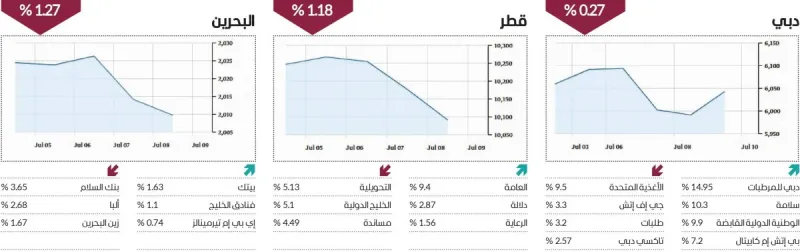
A cautious, wait-and-see mood dominated the performance of most Arab stock exchanges during last week's trading, with this negative performance reflecting a clear decline in investors' appetite for risk, as they preferred to adopt defensive positions and exit buying positions.
Investor confidence was directly affected by the return of geopolitical tensions in the region. Setting aside these prevailing political pressures, Arab markets are in a state of cautious anticipation as they await the start of the disclosure season for listed companies' second-quarter results.
Investors are looking to these financial reports to assess the ability of major operating sectors to hold up and generate profits, hoping that the results will carry internal catalysts and strong positive signals that contribute to restoring stability to indices and offsetting losses left by recent pressures.
The Dubai market managed to achieve weekly gains of approximately 640.4 million dirhams, despite its index declining 0.27% over 5 sessions, supported by the performance of blue-chip stocks in the banking, industrial, and utilities sectors.
The market capitalisation of shares listed on the Dubai market rose from 997.7 billion dirhams at the close of the previous Friday's session to 998.34 billion dirhams at the close of yesterday's session.
Dubai Refreshments led Dubai market gains over 5 sessions, surging 14.95%. Salama shares rose 10.3%, National International Holding 9.9%, BHM Capital 7.2%, Drake & Scull 6.9%, and Agility Logistics 5.2%.
In contrast, United Foods shares fell 9.5%, GFH 3.3%, Talabat 3.2%, Dubai Taxi 2.57%, and Dubai Investments 2.37%.
The FTSE Abu Dhabi General Index (FADGI) rose 0.37% to 9,936.08 points, gaining approximately 6.8 billion dirhams over 5 sessions.
In the Abu Dhabi market, Oman and Emirates Investment shares rose 9.4%, Al Buhaira National Insurance 7.5%, e& 5.3%, Al Wathba National Insurance 5.02%, and Fujairah Building Industries 3.7%.
In contrast, Phoenix Group shares fell 7.9%, Orascom 7.2%, GFH 6.13%, National Corporation for Tourism and Hotels 5%, and Hayat Insurance 4.55%.
The Saudi stock market closed its weekly trading ended on 9 July on a decline, after the market's general index opened the week's trading at 10,830.93 points. Sessions saw normal fluctuations that pushed the index to its weekly high of 10,854.92 points, before it retreated under temporary selling pressure to record its weekly low of 10,775.19 points.
At the close of the final session, the index settled at 10,808.43 points, recording a limited weekly loss of 18.55 points, equivalent to a slight decline of 0.17% compared to opening levels.
Approximately 1.07 billion shares were traded through more than 1.98 million transactions, with investors injecting total liquidity exceeding 19.64 billion riyals. The total market capitalisation of listed companies stood at approximately 9.57 trillion riyals.
Inaya Qaimah topped the list of the week's biggest decliners, falling 15.85%, followed by Thamarat with a drop of 13.49%, then Tibaa and Packaging, which lost 11.95%. On the other side, Saudi Paper Manufacturing led individual stock weekly gains, rising 16%, followed by Luberef at 8.98%, then Ri'aya at 8.09%.
The main indices of the Kuwait Stock Exchange posted a decline at the end of the week's trading, with the Premier Market index slipping marginally by 0.02% to 9,090.48 points, while the Main Market index fell approximately 2.08%, shedding 186.63 points to record 8,769.01 points.
The All-Share Market index declined 0.38%, or 33.09 points, to close the weekly trading at 8,663.33 points. In contrast, the Main Market 50 index rose to 10,000.1 points, achieving a weekly gain of 0.14%, equivalent to 14.31 points.
In terms of trading activity, the volume of shares traded rose 21.48% to reach approximately 1.64 billion shares over the course of the week.
This upward growth was accompanied by a recovery in liquidity levels, which grew by more than 5% to record a total value of approximately 391.01 million dinars, while the total number of executed transactions increased by 2.82% to reach 108,190 deals.
Al Emiratiya shares topped the list of the week's biggest gainers with growth of 16.67%, followed by Shuaiba, which rose 14.96%, then Sanam at 10.43%. On the other side, Gulf Insurance Group led the list of the week's biggest losers with a decline of 29.38%, followed by Al Takadum, which fell 17.32%, then Thuraya at 15%.
The Qatar Stock Exchange recorded a notable decline during the week's trading, with the general index falling 1.18%, equivalent to 120.59 points, to close its weekly trading at 10,090.57 points compared to the previous week's close, amid a near-broad decline across traded sectors.
Regarding trading activity and liquidity levels over the course of the week, investors injected total liquidity of approximately 1.53 billion riyals, which was turned over through the exchange of 632.13 million shares. This trading was conducted through the execution and conclusion of 97,040 transactions on the trading floor.
In terms of individual stock performance and price movements during the week, Al Tahwiliya topped the list of the most declining shares with a decline of 5.13%, followed in second place by Gulf International, which retreated 5.1%, then Musanada and QAMCO, each falling 4.49%.
In contrast, a limited number of stocks managed to achieve weekly gains, with Al Amma Company topping the list of the biggest gainers with a strong rise of 9.4%, followed by Dlala at a growth rate of 2.87%, then Al Ri'aya, which rose 1.56%, and finally Dukhan Bank at a rise of 0.93%.
Bahrain Bourse closed its weekly trading on a decline in its main indices, affected by selling pressure that dominated trading activity and controlled the direction of blue-chip stocks and listed companies.
The Bahrain All-Share Index fell 1.27% to close at 2,009.72 points. The Bahrain Islamic Index was not immune to this decline, recording a sharper drop of 1.85% to end its weekly trading at 943.76 points.
Share movements reflected a clear dominance of the selling side, with declines covering 15 companies that closed in the red, against gains by only 3 companies that managed to escape the wave of decline and achieve weekly gains.
Betek topped the market's gains during the week, rising 1.63%, followed by Gulf Hotels at 1.1%, then APM Terminals at 0.74%. In contrast, Al Salam Bank shares fell 3.65%, Alba 2.68%, and Zain Bahrain 1.67%.
On the other hand, Muscat Stock Exchange bucked the trend of most regional markets this week, closing on broad gains and notable market advances. The main Muscat 30 index managed to close at 7,644.45 points, recording growth of 0.91% (equivalent to 69.23 points) compared to last week's close, supported by broad gains across sectoral indices.
The market saw notable cash inflows and activity, with the total volume of shares traded jumping 14.49% to reach 494.9 million securities, accompanied by stable trading values of 247.87 million Omani riyals.
Regarding individual stock performance, Al Hassan Engineering (under liquidation) topped the list of the week's biggest gainers after achieving a jump of 50%, followed by Oman India Fertiliser Company with a rise of 23.72%, then Oman Cement, which rose 8.33%.
In contrast, some stocks suffered varying losses, led by Sohar Power with a decline of 11.76%, followed by Al Maha Ceramics, which fell 8.3%, then Oman Fisheries Company, which ended its week with a drop of 4.17%.