
Global financial markets experienced an eventful week, in which geopolitical files asserted themselves as one of the most significant drivers shaping capital flows and investment decision-making.
A mood of caution and anticipation prevailed among traders, who kept developments in the ongoing US–Iran talks under close scrutiny, as the global investment community recognises that any progress on that front could redraw the map of credit and operational risks across vital sectors ranging from energy to technology.
This intense investment focus was directly reflected in commodity markets, which spent the week oscillating in response to news emerging from negotiating corridors.
When signs of a possible easing relating to navigational security in the Strait of Hormuz appeared on the horizon, investors breathed a relative sigh of relief, guiding crude oil prices to a stability that tilted toward a marginal decline, driven by hopes that supply obstacles would be removed.
Gold, meanwhile, seized the opportunity to catch its breath as a safe haven, posting notable gains as investors continued to seek a hedge against any surprises that might arise from the complex diplomatic landscape.
Equity markets were not insulated from this environment. Despite the release of mixed US employment data and remarks by the Federal Reserve chairman, cautious optimism over ending the conflict accompanied trading activity, helping the major Wall Street indices and European exchanges to record a green weekly result and reach fresh record highs.
In a shortened trading week owing to a Friday holiday, the major US indices posted collective gains.
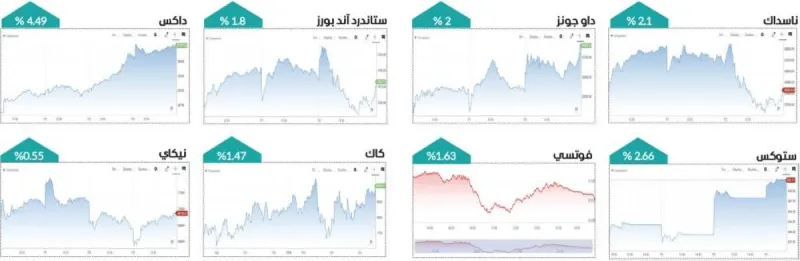
The broad-based S&P 500 rose 1.8%, closing at 7,483.24 points.
The 30-stock Dow Jones Industrial Average jumped 2%, reaching a new record closing level of 52,900.07 points.
The technology-focused Nasdaq rose 2.1%, closing at 25,832.672 points.
Traders followed numerous key developments and data releases during the week, including those linked to US–Iran talks on ending the war, as well as the latest remarks from Federal Reserve Chairman Kevin Warsh.
Also in focus was the Thursday employment report for June, which showed an addition of 57,000 jobs — below the expectations of economists surveyed by Dow Jones, who had forecast 115,000 jobs.
Nevertheless, the unemployment rate fell to 4.2%, after economists had expected it to hold steady at 4.3%.
On the performance of several major stocks, Amazon recorded weekly gains of approximately 7%, while Meta rose by more than 7%, Microsoft by more than 10.5%, and Tesla by approximately 5%.
European equity markets posted a notably positive performance during the week ending 2 July 2026, with major indices closing higher across the board, driven by strong gains in the healthcare and consumer goods sectors.
In terms of weekly index performance, the pan-regional Stoxx 600 rose 2.66%, adding 16.89 points to close the week at 652.77 points, up from its previous close of 635.88 points.
Germany's DAX also advanced by 1,108.09 points, a gain of 4.49%, closing at 25,779.31 points compared with its previous close of 24,671.22 points.
British and French markets were equally caught up in this upward momentum. The UK's FTSE rose 171.01 points, recording a change of 1.63%, lifting its closing level to 10,679.03 points from 10,508.02 points the previous week.
France's CAC ended the week at 8,508.07 points, compared with its previous level of 8,384.87 points, posting a gain of 123.20 points, equivalent to growth of 1.47%.
The major Asian indices closed the week with a clear divergence in performance, as market movements were split between buying-driven gains and corrective declines in some other markets, amid investor anticipation of economic developments.
Japan's Nikkei rose 0.55%, ending trading at 69,744.07 points compared with 69,360.88 points at its previous close, with the advance reflecting a degree of relative stability and caution among the country's investors.
In a related vein, Hong Kong's Hang Seng rose 2.99%, jumping from 22,671.86 points to 23,350.03 points, supported by selective buying across vital sectors.
By contrast, South Korea's Kospi bucked the broader positive trend, coming under selling pressure that pushed it down 3.84%.
The South Korean index closed at 8,088.34 points, having recorded 8,411.21 points in its previous reading the week before.