
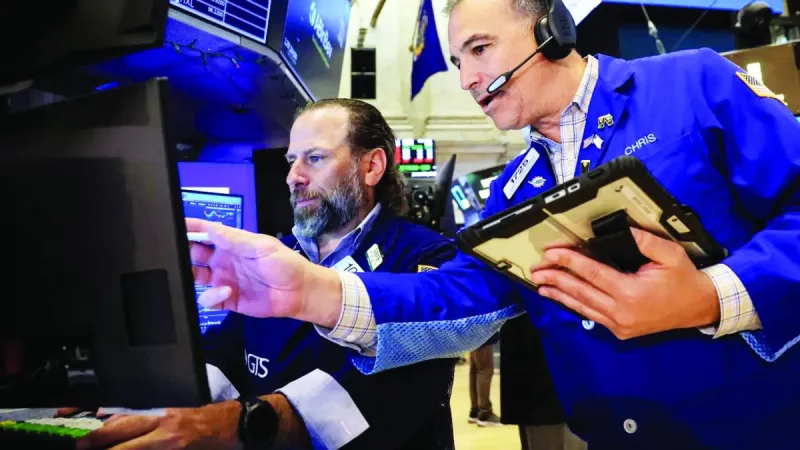
Global markets got off to a strong start to the trading week, buoyed by an improvement in investor risk appetite following a ceasefire agreement between the United States and Iran, which eased concerns about disruptions to global energy supplies and restored momentum to equity markets. The gains came alongside continued bets on the strength of the artificial intelligence and semiconductors sectors, as investors awaited meetings of major central banks and US jobs data that will set the direction of monetary policy in the period ahead, while oil prices remained relatively elevated amid continued caution over any new geopolitical developments in the Middle East.
US stocks rose during Monday's session as investor risk appetite improved, supported by the ceasefire agreement between the United States and Iran, which boosted hopes of containing geopolitical tensions in the Middle East, despite ongoing caution about the future of the truce.
The Dow Jones Industrial Average climbed more than 365 points, while the S&P 500 rose approximately 1.1% and the Nasdaq Composite jumped around 1.9%, with technology and artificial intelligence stocks leading the advance.
Alphabet was among the top gainers, rising more than 4% in its first trading session as a component of the Dow Jones Industrial Average, while Comcast surged around 6% after announcing plans to spin off its media and technology businesses into two separately listed companies over the coming year.
The gains came at the start of a shortened trading week ahead of the US Independence Day holiday, which could heighten market volatility as liquidity declines coinciding with the end of the financial quarter.
News of the ceasefire between Washington and Tehran bolstered investor confidence, following an agreement to resume technical talks and allow the passage of commercial vessels through the Strait of Hormuz, despite lingering concerns about the possibility of renewed escalation.
In energy markets, Brent crude rose approximately 1.2% to $72.87 per barrel, while West Texas Intermediate climbed 1.7% to $70.38, as traders assessed the durability of the de-escalation agreement and its implications for global oil supplies.
Securitize also announced it will list its shares on the Nasdaq exchange on Thursday, becoming the first US company specialising in asset tokenisation to enter public markets, while 28 stocks in the S&P 500 hit their highest levels in 52 weeks, signalling a broadening of the market's recovery.
European stocks closed flat after gains by technology companies offset losses in the construction sector, while investors continued to assess the sustainability of the US–Iran ceasefire.
The pan-European Stoxx 600 index rose 0.1%, with the technology sector leading gains with a rise of 1.2% after a selling wave that had posted its largest weekly losses since mid-March came to a halt.
Chipmaker stocks rose, most notably STMicroelectronics, which gained 2.4%, benefiting from a global rebound in the artificial intelligence sector, although analysts note that Europe has yet to fully benefit from the AI-driven production boom compared with the United States and Asia.
Markets this week are focused on the Sintra conference organised by the European Central Bank, which will be attended by senior central bank governors, chief among them the chair of the US Federal Reserve and the president of the European Central Bank, as participants look for fresh signals on interest rates.
Dutch firm Prosus recorded gains of 2.4% following annual profit growth, while Bridgepoint jumped 16% after an acquisition deal was announced. Meanwhile, Heidelberg Materials fell 9.4% after issuing a second-quarter profit warning, and Deutsche Telekom declined 5.5%.
Japan's Nikkei index closed up 0.15% after managing to recover its early losses, supported by an improvement in chip stocks following South Korea's announcement of major investment projects in the semiconductors and artificial intelligence sectors.
The broader Topix index also rose 0.47%, as investors regained confidence in technology stocks following the announcement of large-scale investments led by Samsung Electronics and SK Hynix to expand chip manufacturing.
Tokyo Electron rose 2.44%, while Kioxia trimmed its losses; Advantest fell 1.51%, after sharp volatility in the semiconductor sector at the end of last week.
Nintendo climbed 5.25% and Sony rose 3.13%, while energy and mining stocks declined as fears of a widening conflict in the Middle East receded, with the mining sector falling 1.83% and oil refining companies dropping 1.07%.
Analysts say investors in Japan are increasingly focused on growth opportunities linked to artificial intelligence and semiconductors, at a time when geopolitical tensions are no longer the primary driver of market direction.