
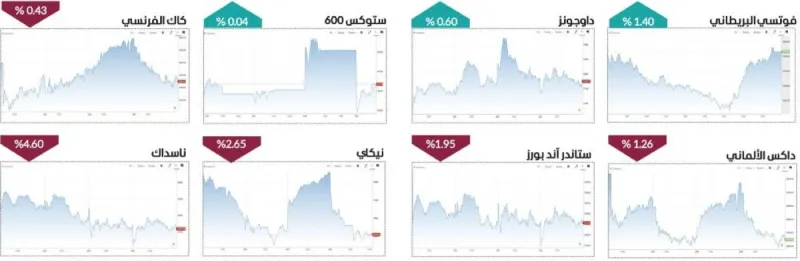
A negative performance overshadowed most global equity indices during the week's trading sessions, as markets surrendered earlier gains and turned broadly lower under the weight of dual pressures combining escalating geopolitical risks and renewed economic concerns.
Uncertainty over developments linked to the Iran war and the financial landscape dominated proceedings, amid cautious questions and deep anxiety over whether the recent US-Iran agreement and memorandum of understanding would hold. Contradictory and turbulent signals from both sides heightened concerns about the collapse of the fragile truce, keeping energy supply flows and navigation through the Strait of Hormuz squarely in the spotlight.
Losses were deepened by intense anticipation over monetary policy, particularly following hawkish signals from US Federal Reserve officials.
Bets intensified in financial circles that the central bank is moving toward adopting a stringent monetary tightening policy and keeping interest rates elevated during the current year to rein in inflation.
US equity indices ended the week's trading on a mixed note that tilted toward clear declines, driven by selling pressure and varied corrective moves that struck the technology sector most notably, while industrial stocks showed relative resilience in the face of this selling wave.
This performance came as markets closely monitored economic and political developments affecting the flow of liquidity on Wall Street.
The Dow Jones Industrial Average was the sole survivor of these declines, managing to close the week higher by drawing on the steadiness of traditional and blue-chip sector stocks. The index rose from its previous level of 51,564.70 points to reach its current level of 51,876.11 points, posting gains of 311.41 points, which translated into positive growth of 0.60%.
By contrast, the broader S&P 500 index failed to maintain its stability, retreating under the weight of large-cap stock declines and sliding from its previous reading of 7,500.58 points to end the week at its current level of 7,354.02 points, recording a loss of 146.56 points, equivalent to a decline of 1.95%.
The heaviest losses fell on the technology sector led by the Nasdaq, which experienced a sharp drop and marked deterioration during the latest sessions. The index fell from its previous close of 26,517.931 points to settle at its current level of 25,297.618 points, shedding 1,220.313 points of its value and registering a steep decline of 4.60%, reflecting the depth of pressure faced by technology and growth companies during the week.
European financial markets posted a notable divergence in performance during the week ending 26 June, with major indices reflecting a tug-of-war between limited gains and selling pressure in some of the largest independent markets.
Looking broadly across the continent, the pan-regional Stoxx 600 index settled nearly flat with a slight upward tilt, rising from its previous level of 635.61 points to close at 635.88 points, posting marginal gains of 0.27 points, which calculations translated into negligible growth of 0.04%.
In contrast, Germany's DAX index led the declines among major markets after being subjected to strong selling pressure that forced it to surrender key support levels, retreating from its previous close of 24,985.82 points to reach its current level of 24,671.22 points.
The German index's losses amounted to 314.60 points, recording a decline of 1.26%, the largest loss among the major European indices during this week's trading.
The French market was not immune to these pressures, with the CAC index in Paris following its German counterpart though with a less severe downward tone. The index retreated from its previous level of 8,421.14 points to settle at the end of the week at its current value of 8,384.87 points, registering a loss of 36.27 points, equivalent to a decline of 0.43%.
On the other side of the ledger, the London Stock Exchange bucked the trend of declines thanks to a strong surge by the British FTSE index, which managed to rise from its previous close of 10,363.27 points to end the week at its current level of 10,508.02 points, posting substantial price gains of 144.75 points, equivalent to growth of 1.40%.
Asian financial markets recorded a red-tinted outcome during the week ending 26 June. Japan's Nikkei index lost 1,889.18 points of its value, declining from its previous level of 71,250.06 points to reach a current level of 69,360.88 points, registering a decline of 2.65% amid clear selling pressure.