
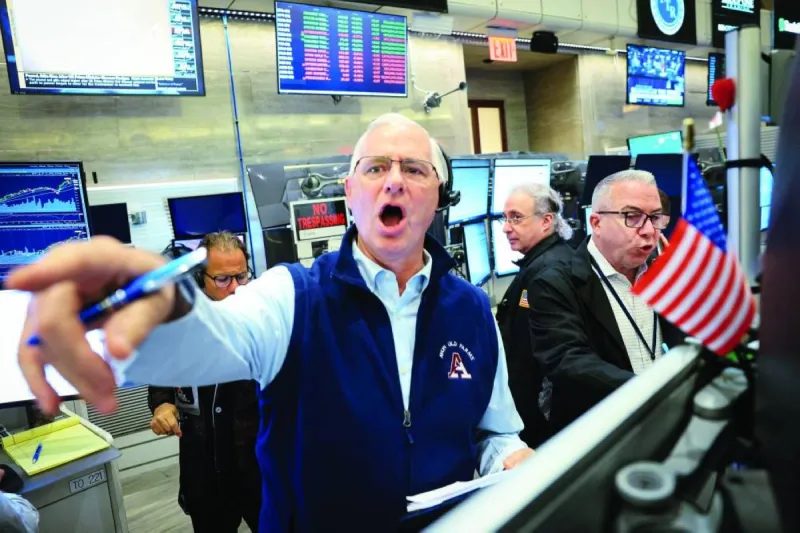
Caution hung over global markets at the start of the week as investors balanced signals of de-escalation in the Middle East against persistent concerns about inflation, interest rates, and the future of energy supplies. Although progress in US-Iran talks eased geopolitical tensions, markets continued to watch closely how durable any ceasefire would prove, the trajectory of negotiations, and the impact on global oil markets in the period ahead.
In the United States, Wall Street opened with a mixed performance following a long holiday weekend, with the S&P 500 falling 0.3% to sit roughly 1.7% below its all-time high recorded at the start of the month, while the Dow Jones Industrial Average rose 195 points, or 0.4%. The Nasdaq, meanwhile, declined 1.2% under pressure from technology stocks.
Inflation remains the focus of investor attention, with US consumer price data due Thursday widely anticipated. Markets expect the inflation rate to rise to 4.1% in May compared with 3.8% in April. The yield on the 10-year US Treasury bond also climbed to 4.50%, up from 3.97% before the outbreak of the war, while market bets point to a significant probability that the Federal Reserve will raise interest rates again before year-end.
On the corporate front, shares in AbbVie surged 6.9% after the company announced its acquisition of Apogee Therapeutics in a deal valued at $10.9 billion, driving the target company's stock up more than 46%. SpaceX shares, by contrast, extended their losing streak for a third consecutive session, falling 10.5%.
In Europe, the Stoxx 600 index closed Monday up 0.6% after two days of declines, buoyed by two main factors. The first was the surprise announcement of British Prime Minister Keir Starmer's resignation as Labour Party leader, which lifted UK banking stocks — Barclays rose 3.9%, NatWest gained 4%, and Standard Chartered added 1.3%.
The second factor was the announcement of a roadmap for US-Iran negotiations, which boosted hopes for a return of stability to global energy markets and eased concerns about navigation through the Strait of Hormuz, despite continued uncertainty about developments in the region.
In Asia, equity markets continued to post strong gains led by the artificial intelligence sector, with Japan's Nikkei 225 crossing the 72,000-point threshold for the first time in its history, setting a new record of 72,831 points during the session before closing up 1.55% at 72,353 points — its eighth consecutive session of gains.
The rally was driven by government plans to boost investment in strategic sectors, including artificial intelligence and semiconductors, with investments projected to reach 370 trillion yen by 2040. South Korea's Kospi rose 0.4%, supported by gains in chipmaker stocks, while Taiwan's benchmark index climbed 2.8% and India's rose 0.6%. Hong Kong's Hang Seng, by contrast, fell 1%.
Oil markets saw sharp swings during the session after Brent crude opened above $82 per barrel, supported by concerns over the Strait of Hormuz and hawkish US statements toward Iran, before the picture shifted quickly following confirmation by US Vice President JD Vance that progress had been made in negotiations with Tehran and that the strait remained open to shipping traffic.
These developments pushed oil prices sharply lower, with Brent crude falling to $77.39 per barrel for a loss of nearly 4%, while West Texas Intermediate dropped to $74.45 per barrel. Prices were further pressured by confirmation that Iranian oil exports had resumed and crude flows through the Strait of Hormuz had returned.
At the same time, the UAE, Kuwait, and Iraq announced increases in oil supply to customers, while Iraq revealed plans to gradually restore its production to between 4.2 and 4.3 million barrels per day, reinforcing market expectations that a significant portion of Gulf supplies would return over the coming weeks.
In another indicator of the pressures bearing on energy markets, data from the US Department of Energy showed the strategic petroleum reserve falling to 331.2 million barrels — its lowest level since 1983 — after a weekly decline of more than 9 million barrels.
Attention in the days ahead will remain fixed on three key files: the outcome of US-Iran negotiations, US inflation data, and the pace at which oil supplies return to global markets — factors seen as the most influential in shaping market direction in the third quarter of the year.