
Global markets experienced a turning point this week, driven by a rich mix of political and economic developments, as a wave of optimism and broad relief swept trading floors following the announcement of a formal agreement between Washington and Tehran bringing the ongoing war to an end.
This prominent geopolitical event lifted investor sentiment, easing the level of risk that had weighed on the global economy for an extended period, and paving the way for a tangible recovery in global equity indices and energy markets, which breathed a sigh of relief as vital shipping lanes were reopened.
At the same time, the backdrop was not without its complexities, as investors kept their eyes firmly fixed on the corridors of monetary policy, awaiting the US Federal Reserve's interest rate decision.
As widely expected, the central bank opted to hold interest rates unchanged — a decision that offered markets some temporary reassurance, signalling policymakers' desire to closely monitor a succession of incoming economic data before taking their next step.
US stock indices closed the shortened trading week — limited to just four sessions due to Friday's holiday — with broad-based gains.
Markets digested the first interest rate decision issued by the Federal Reserve under its new chairman Kevin Warsh, whose inaugural meeting sparked heated debate amid the challenges of rebounding inflation and geopolitical tensions.
The Fed was not the only star of the week, however; the historic listing of Elon Musk's SpaceX on the Nasdaq exchange ignited unparalleled enthusiasm on Wall Street, reflecting the largest initial public offering in history.
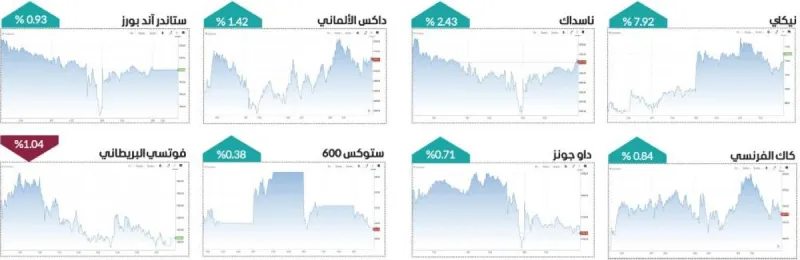
The technology-heavy Nasdaq index was the biggest winner and most active over the four sessions, jumping 629.087 points to post a weekly gain of 2.43%, closing at 26,517.931 points.
Traditional sectors were not left behind either, as the broader S&P 500 index touched new levels, rising 69.12 points, or 0.93%, to close at 7,500.58 points.
The Dow Jones Industrial Average maintained its upward trajectory, albeit at a relatively subdued pace compared with its counterparts, gaining 362.44 points — equivalent to a rise of 0.71% — to end the week at 51,564.70 points.
European financial markets also closed the week on a notably positive note, buoyed by increased investor risk appetite and improved business confidence in the eurozone's largest economies.
This optimism was directly reflected in the performance of the regional Stoxx 600 index, which serves as a mirror of major European companies' performance; the index climbed from its previous level of 633.21 points to reach 635.61 points, posting a weekly gain of 2.40 points, equivalent to a rise of 0.38%.
Germany's DAX index rose from its previous close of 24,635.30 points to settle at its current level of 24,985.82 points, gaining 350.52 points in full and recording the highest percentage gain among its peers at 1.42%.
The Paris Bourse was equally caught up in the optimistic mood, with the CAC 40 index attracting solid investment inflows. The French index surpassed its previous level of 8,350.87 points to close at 8,421.14 points, translating into a positive change of 70.27 points, or a gain of 0.84%.
On the other side, the London Stock Exchange struck a discordant note from its European counterparts. The UK's FTSE 100 index fell from its previous level of 10,471.72 points to 10,363.27 points, recording a loss of 108 points, or a decline of 1.04%, making it the sole exception in an otherwise green European closing picture.
Asian financial markets experienced a week marked by notable divergence, with the Tokyo and Seoul exchanges leading the charge in gains driven by strong investment momentum, while the Hong Kong Stock Exchange bucked the trend to record a negative close.
Japan's Nikkei index posted a jump that significantly bolstered its weekly gains, closing at 71,250.06 points compared with its previous level of 66,020.04 points.
This rise was driven by record activity in technology and exporter stocks, with the index recording a positive change of 5,230.02 points and a strong growth rate of nearly 7.92%, reflecting renewed confidence from global funds in Japanese equities.
The scene in South Korea was no less dramatic; the Seoul Stock Exchange exceeded expectations after the Kospi index surged by more than 11%.
The index leapt to 9,052.42 points from its previous close of 8,123.62 points, recording a gain of 11.43%, equivalent to a change of 928.80 points.