
Most major indices in Arab financial markets posted positive performance last week, with green dominating trading screens across the majority of regional bourses, buoyed by a wave of optimism that swept investor circles, boosting liquidity levels and pushing indices toward new record highs.
The positive momentum was driven directly by prominent geopolitical developments at the regional and international level, foremost among them the announcement of a peace agreement between the United States and Iran — a deal that brings an end to the state of conflict and war that had for an extended period formed a powerful and persistent pressure on market sentiment and investment activity.
As geopolitical pressures begin to ease, investors are now gripped by a strong sense of optimism about a return to normalcy and the restoration of calm and stability in the region. Analysts believe this new climate will rebuild confidence in the Arab investment environment, paving the way for foreign capital inflows and the sustainability of economic recovery.
The Dubai Financial Market continued its strong performance last week, with the index rising 3.52% to 6,163.5 points. Storage, investment, aviation, real estate, and banking stocks led the gainers, with Makhazin surging 21.1%, followed by Al Mal Capital Right up 14.4%, Air Arabia up 10.9%, Emaar rising 10.8%, and Emirates NBD up 8%.
On the decliners side, BHM Capital fell 5.8%, Dubai Refreshments dropped 5%, Talabat slipped 3%, Etihad Energy lost 2.8%, and Emirates REIT declined 2.5%.
The Abu Dhabi Securities Exchange index rose 2.1% last week to close at 10,017 points, led by a number of financial, banking, logistics, insurance, investment, and real estate stocks. Insurance, real estate, and energy shares topped the gainers, with Dar Al Takaful up 19.7%, Al Dhafra Insurance up 14.9%, Aldar Properties rising 14.2%, RAK Properties up 13.7%, and Taqa up 12%.
Easy Lease led the decliners, falling 12.5%, followed by National Hotels down 6%, Abu Dhabi National Hotels down 5.2%, Fujairah Cement down 4.9%, and Gulf Investment Corporation down 4.8%.
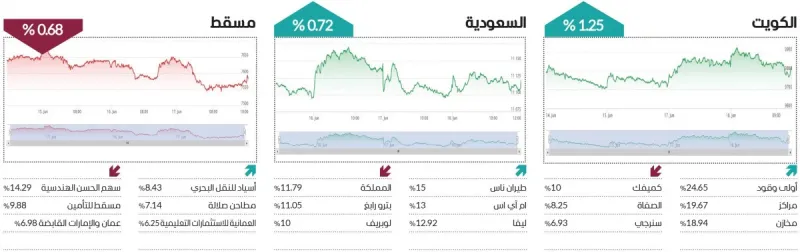
The Saudi market closed last week's trading on a positive note, after the general market index opened the week's sessions at 11,090.61 points. Sessions recorded broadly positive movements that pushed the index to its weekly high of 11,172.15 points.
Despite mild selling pressure that dragged the index at times to 11,085.62 points, buying forces succeeded in steering it upward, with the general index closing the week at 11,121.13 points, posting net gains of 79.11 points, equivalent to positive growth of 0.72% compared with the previous weekly close.
In terms of trading activity and market performance, sessions were characterized by strong momentum with the participation of 268 listed companies whose shares were actively traded. Investors injected substantial liquidity totalling more than 26 billion riyals, through approximately 1.2 billion shares across 2,084,757 executed transactions. The total market capitalisation of the Saudi stock market stood at approximately 9.65 trillion Saudi riyals.
In terms of individual stock performance, Nas Air topped the list of the week's best performers with gains of approximately 15%, followed by MIS which rose by more than 13%, then Leejam with gains of 12.92%. On the other side, Al Mamlaka topped the weekly losers with a decline of 11.79%, followed by Petro Rabigh which fell 11.05%, then Luberef down 10%.
Kuwaiti indices posted a green result for the week, with the Premier Market index rising 0.37% to close at 9,220.73 points, the All-Share index rising 0.43% to 8,760.16 points, and the Main Market 50 index climbing 1.25% to close at 9,807.71 points. The market capitalisation of traded shares at the end of the week stood at 52.49 billion dinars.
Weekly trading volumes rose to 2.48 billion shares, with trading values recording 654.62 million dinars across 135,810 transactions.
Oula Fuel topped the weekly gainers with growth of 24.65%, followed by Marakez up 19.67%, then Makhazin up 18.94%. On the other side, KAMCO topped the decliners with a fall of 10%, then Al Safat down 8.25% and Synergy down 6.93%.
The Qatar Stock Exchange general index posted weekly gains of 2.41%, or 247.040 points, closing at 10,510.920 points, amid broad-based rises across sectoral indices with the exception of the telecommunications sector, which fell 0.5%.
The market capitalisation of traded shares at the end of the week reached 635.6 billion riyals, while weekly trading values totalled approximately 2.8 billion riyals, with trading volumes of around 956 million shares across 130,738 transactions.
Lesha Bank topped the list of the week's biggest gainers with weekly gains of more than 13%, followed by Makhazin up 9.25%, then Doha Bank up 9.19%. Industries Qatar topped the weekly losers with a decline of 2.95%, followed by Cinema with a loss of 1.19%, then Zad down 1%.
Bahrain Bourse closed the week ending June 18 with notable gains and strong advances across its main indices, supported by broad buying activity concentrated in blue-chip stocks. The Bahrain All-Share index recorded growth of 2.36%, ending the week at 2,028.09 points.
In a related development, the Bahrain Islamic index joined the upward trend, posting gains of 1.52% to close at 973.66 points. In terms of trading activity and liquidity, the total value of shares traded during the week amounted to 5,261,428 dinars, while the total volume of shares traded was 12,449,873 shares.
Regarding the performance of listed companies and stock movements, the market saw a clear dominance of gainers; shares of 13 listed companies rose, directly contributing to pushing the indices into positive territory and confirming the market's upward trajectory. In contrast, shares of only 3 companies declined. UGIC topped the gainers list with weekly gains of 15.15%, followed by ALBH with gains of 7.78%, then ZAINBH up 4.31%. The weekly losers list was topped by ITHMR, which fell 13.89%, followed by ESTERAD down 2.38% and BCFC down 0.85%.
In Oman, the Muscat Stock Exchange 30 index recorded a weekly loss of 0.68%, closing at 7,582.72 points compared with 7,634.39 points at the end of the previous week. The decline came amid a near-universal pullback across the main sectoral indices, including the industrial sector index and the services sector.
Total securities traded during the week fell by more than 30%, total trading value also declined by more than 27%, and the number of transactions dropped by more than 24%, according to the weekly trading data report issued by the Muscat Stock Exchange.
Al Hassan Engineering (under liquidation) topped the weekly losers with a decline of 14.29%, followed by Muscat Insurance which incurred a loss of 9.88%, then Oman and Emirates Holding down 6.98%. On the other side, Asaad for Marine Transport topped the weekly gainers with a rise of 8.43%, followed by Salalah Mills up 7.14%, then the Omani Educational and Training Investment Company with gains of 6.25%.
The Egyptian Exchange posted positive performance last week, with market capitalisation generating strong profits exceeding 92 billion pounds in a shortened week of 4 sessions, as the bourse was closed on Thursday for an official public holiday marking the Islamic New Year.
The main EGX30 index jumped by more than 0.70% to close at 64,379.63 points, supported by a return of risk appetite and improved liquidity.
Trading saw heightened activity as institutional and fund buying returned in force, in addition to retail investor demand for purchases to capture opportunities after many listed company shares reached price levels that were attractive for buying.