
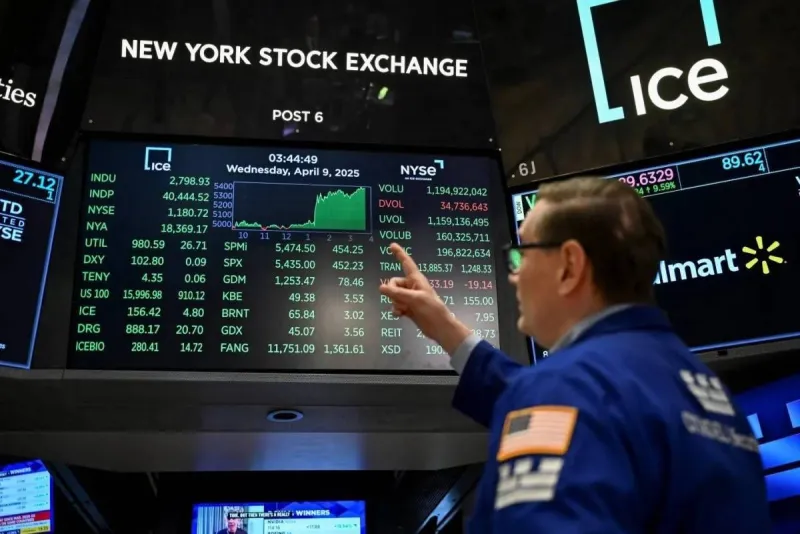
Global markets extended their wave of optimism for a second consecutive day, buoyed by the preliminary agreement between the United States and Iran to end tensions and reopen the Strait of Hormuz to oil trade.
Crude prices fell to their lowest levels in three months, while Japan's Nikkei index achieved a historic milestone by surpassing the 70,000-point level for the first time, even as the Bank of Japan raised interest rates to their highest level in more than three decades.
European markets opened positively on Tuesday, with France's CAC index rising 0.75%, Germany's DAX gaining 0.07%, Italy's FTSE MIB jumping 1.15%, and the pan-European STOXX index climbing 0.25%.
The UK's Financial Times index rose 0.66%, as investors assessed the implications of the US-Iran agreement and its impact on energy markets and inflation.
US stocks rose at the open as oil prices continued their decline, falling to $80 per barrel for the first time since early March.
The broad-based S&P 500 index gained 0.1%, leaving it just 0.6% below its all-time high recorded earlier this month. The Dow Jones Industrial Average rose 395 points, or 0.99%, while the Nasdaq Composite was nearly unchanged.
The technology sector maintained its role as a key driver of global markets, supported by the significant momentum generated by SpaceX's initial public offering, which lifted the company's market capitalisation to more than $2 trillion after its shares surged more than 20% during the first trading sessions.
This optimism was reflected in the shares of artificial intelligence and data centre companies worldwide, while chipmakers continued to attract investor interest amid growing global demand for AI and cloud computing technologies.
In a notable move, Nvidia, the world's largest AI chipmaker by market capitalisation, announced a $25 billion bond offering aimed at bolstering liquidity and funding future operational and expansion purposes.
In Asia, the Japanese market stole the spotlight after the Nikkei 225 index surpassed the 70,000-point level for the first time in its history, before paring some of its gains to close near 69,400 points.
This came in tandem with the Bank of Japan's decision to raise its benchmark interest rate by a quarter of a percentage point to 1%, the highest interest rate level in the country since 1995, in a move aimed at countering inflationary pressures linked to rising energy costs.
Despite the decision, the Japanese yen held steady near 160 yen to the dollar, signalling that markets had already priced in the monetary tightening move, with investors viewing the central bank as still pursuing a gradual approach that does not threaten liquidity levels or corporate profits.
Asian markets posted mixed performance, with South Korea's KOSPI continuing its advance toward record levels, while Hong Kong's Hang Seng index and China's Shanghai Composite retreated on profit-taking. Indian and Taiwanese markets recorded strong gains driven by continued investor flows into technology stocks and advanced industries.
Investors are awaiting upcoming monetary policy decisions from the US Federal Reserve and the Bank of England, as the yield on 10-year US Treasury bonds fell to around 4.45%.
Gold prices rose, approaching new record levels, as investors continued to bet on the start of a monetary easing cycle in the coming months. Despite the clear improvement in risk appetite, markets are still closely monitoring decisions from major central banks to assess the trajectory of interest rates during the second half of the year.