
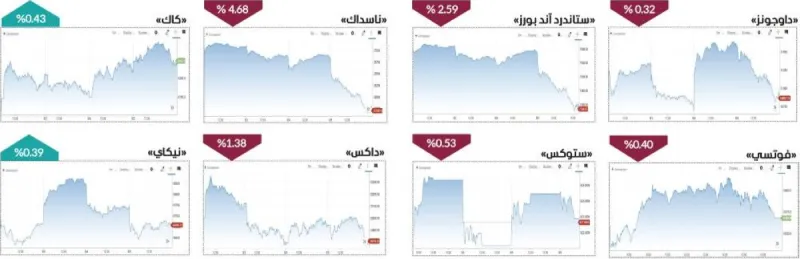
Global financial markets endured one of their most turbulent weekly sessions as major indices buckled under mounting selling pressure amid an escalating geopolitical tone.
The red that swept across most trading screens was an immediate reflection of the extreme caution gripping investor appetite in the world's leading trading floors, from New York to the capitals of the Old Continent. Concerns linked to the Iranian file and developments in the Middle East drove a wave of capital repositioning, pushing traders to flee high-risk assets in favour of more conservative havens.
This murky landscape did not spare commodity markets from its volatility. Oil prices flared, driven by supply disruption fears, while gold's lustre dimmed — particularly after a positive US jobs report reinforced the likelihood of further monetary tightening and interest rate hikes, reshuffling global investment priorities in the face of political and economic headwinds.
US financial markets had a gruelling week, with all three major indices declining collectively under clear selling pressure, reflecting the caution and uncertainty dominating investors.
The Nasdaq technology index was the week's biggest casualty, subjected to intense pressure from profit-taking and fears over elevated technology-sector valuations.
The index fell from its previous closing level of 26,972.62 points to end current trading at 25,709.432 points, recording a loss of 1,263.188 points — a sharp decline of 4.68% — making it the worst performer among the three indices. Friday marked its worst single day since April 2025.
The broader S&P 500 was not spared from the downturn, as the general deterioration in market sentiment weighed on most of its key sectors.
The index opened the week supported by a previous close of 7,580.06 points but succumbed to pressure, retreating to 7,383.74 points at the current close — a loss of 196.32 points, equivalent to a decline of 2.59%.
The Dow Jones Industrial Average, by contrast, showed relatively greater resilience compared to its peers, benefiting from the diversification of its blue-chip holdings in traditional sectors such as defence and energy, which provided investors with a partial safe haven.
Nevertheless, the index was unable to escape the red zone, falling from its previous level of 51,032.46 points to close at 50,866.78 points — a modest decline of 165.68 points, or 0.32%.
Against the backdrop of markets closely tracking rapidly developing events linked to the war with Iran and the scenarios that may follow, red dominated the weekly performance of European indices, with a mood of caution and risk aversion prevailing among investors and pushing most major indices to surrender earlier gains.
The Stoxx index posted a limited decline reflecting the general anxiety, falling from its previous level of 626 points to close at 622.66 points, a drop of 0.53%.
Germany's DAX was the biggest loser among major European indices this week, weighed down by the sensitivity of Germany's industrial sector to any potential disruptions in energy prices. The index fell from its previous level of 25,104.70 points to 24,759.05 points, suffering a decline of 1.38%.
The British market was not immune to the gloom either, as the FTSE retreated from its previous close of 10,409.28 points to settle at 10,368.05 points, recording a negative change of 0.40%.
France's CAC, however, bucked the prevailing downward trend by a slim margin, rising from its previous level of 8,183.34 points to 8,218.24 points, achieving a gain of 0.43%.
These price movements confirm that equity markets across the Old Continent remain hostage to geopolitical developments, with traders preferring extreme caution while awaiting clarity on forthcoming scenarios in the Middle East and their direct impact on the global economy.
Asian markets, meanwhile, showed notable divergence in their weekly performance as investor caution and anticipation dominated decision-making, directly affecting major indices. While Japanese equities managed to hold on to gains, South Korean markets led the decline with sharp falls.
Japan's benchmark Nikkei index of the country's largest companies managed to hold firm and defy the region's prevailing downward trend, supported by resilience in certain export and blue-chip sectors. The index rose from its previous level of 66,329.50 points to close at 66,588.12 points, gaining 0.39%.