
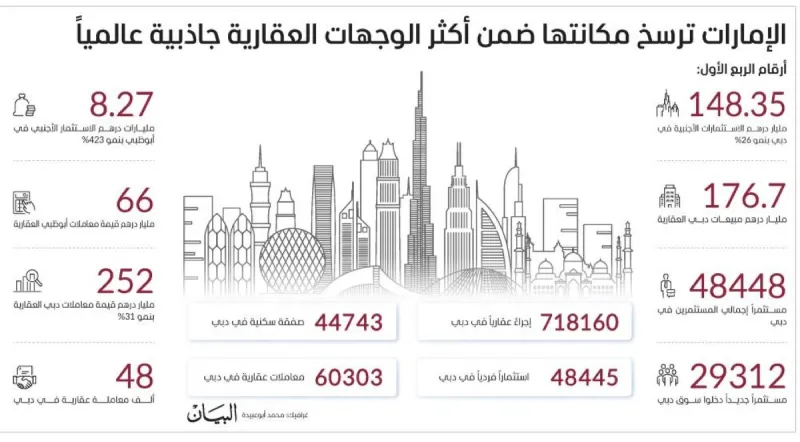
The real estate sector in the United Arab Emirates is entering a new phase of structural development and maturity in 2026 and 2027, supported by a range of economic and structural factors that reinforce sustainable growth and reshape market dynamics beyond traditional cycles.
Amid record inflows of foreign capital, accelerating population growth, and expanding long-term residency programmes, the UAE market continues to cement its status as one of the world's most attractive real estate destinations.
According to analytical readings from a number of leading decision-makers and real estate experts, the market is moving towards a more mature and balanced phase in which quality and long-term value will be the decisive factors in investment decisions, alongside growing supply and increasing reliance on modern technology and artificial intelligence.
As Dubai and Abu Dhabi continue to record all-time highs in sales and real estate transactions, questions are being raised about the market's ability to sustain its current momentum and its growth prospects in the coming years amid shifting global economic and geopolitical variables.
Mohamed Al Saleh Saqan, Chief Executive Officer of Access Consult and a member of Excellence Consortium Group, said that domestic and international demand will continue to support the UAE real estate market in 2026 and beyond, although the nature of that demand has become more mature and sustainable.
He explained that, on the international front, the UAE continues to benefit from its position as a stable, transparent, and globally connected investment destination. In Dubai, the value of foreign investments reached 148.35 billion dirhams (AED) during the first quarter of 2026, according to the Dubai Land Department.
Abu Dhabi, meanwhile, recorded 423% year-on-year growth in foreign direct investment, which reached 8.27 billion dirhams, according to the Abu Dhabi Real Estate Centre, reflecting the entry of international capital into the market with a long-term investment outlook.
He added that domestic demand is seeing continuous growth as more residents come to regard the UAE as a permanent home rather than a temporary work posting, driven by long-term residency programmes — most notably the Golden Visa — alongside the strength of the national economy and ongoing infrastructure development under initiatives such as the Dubai Urban Master Plan 2040.
On the subject of new supply, Saqan noted that the delivery of new residential units during 2026 will contribute to enhancing the health of the UAE real estate market, making it more balanced and diversified.
He explained that the increase in supply in Dubai will help achieve greater stability in the rental sector, while demand in Abu Dhabi is expected to remain strong, supporting continued price resilience — particularly with the addition of 10,272 new residential units during the current year.
He stressed that the most significant impact of new supply will be to reinforce what is known as the