
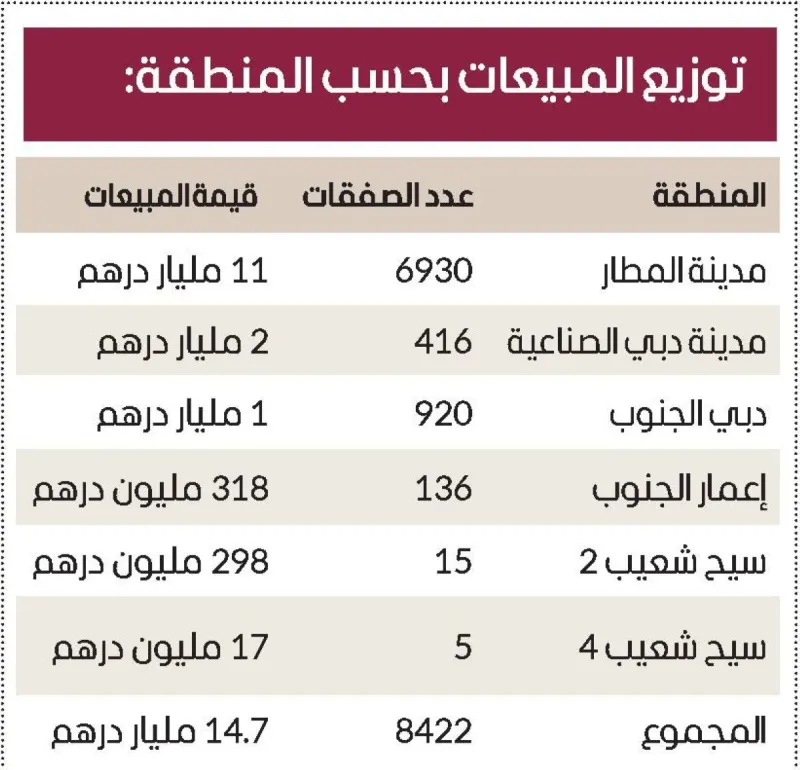
The areas surrounding Al Maktoum International Airport in Dubai have recorded real estate sales exceeding 14.7 billion dirhams (AED), spread across 8,422 transactions — an indicator reflecting the growing real estate activity in a region preparing to host the world's largest aviation hub.
Al Bayan based this analysis on data from the Dubai Land Department covering real estate sales in the areas surrounding the airport since the beginning of 2026, which included: Airport City, Dubai South, Dubai Industrial City, Emaar South, Saih Shuaib 2, and Saih Shuaib 4.
The data showed that Airport City captured the largest share of activity, with a total of 6,930 transactions valued at approximately 11 billion dirhams — equivalent to around 75% of total sales value across all areas covered.
Airport City recorded 6,402 transactions for residential apartments worth 7.7 billion dirhams, 315 villa transactions worth 208 million dirhams, and land transactions exceeding 1.7 billion dirhams.
Dubai Industrial City ranked second with sales of 2 billion dirhams across 416 transactions, including 338 apartment transactions worth 223 million dirhams and 15 villa transactions worth 26 million dirhams. Dubai South followed with 920 transactions worth 1 billion dirhams, including 901 apartment transactions worth 909 million dirhams and 5 villa transactions worth 13 million dirhams.
Emaar South recorded sales of approximately 318 million dirhams through 136 transactions, including 48 apartment transactions worth 71 million dirhams and 80 villa transactions worth 208 million dirhams. Saih Shuaib 2 and Saih Shuaib 4 recorded sales of 298.7 million dirhams across 15 transactions and 17 million dirhams across 5 transactions, respectively.
This activity coincides with the development project of Al Maktoum International Airport, one of the largest strategic projects in the global aviation sector. It is being developed to become the world's largest aviation hub, with a passenger capacity exceeding 260 million annually and a cargo handling capacity of more than 12 million tonnes upon completion of all phases.
The airport will feature five parallel runways with independent operations, two passenger terminals, seven concourse buildings accommodating more than 430 aircraft stands, an integrated automated people-mover system, and a multimodal transport network encompassing air, rail, and road links.
The airport's anticipated expansion will enhance the appeal of surrounding areas, particularly as growing logistics, commercial, and residential activities migrate to its vicinity — supporting demand for all types of real estate in the coming years and making the region one of Dubai's most prominent urban and investment growth hotspots.
The strong sales performance confirms that the real estate market has already begun pricing in the future. Investors are betting that the Al Maktoum Airport project will not merely be an expansion of an existing airport, but a major economic turning point that may gradually shift Dubai's urban and investment centre of gravity southward — opening a new chapter in the emirate's real estate growth cycle.
The accelerating real estate momentum around Al Maktoum Airport signals a pre-emptive shift by investors to seize opportunities before the project is completed, in a scenario reminiscent of what major areas in Dubai witnessed during previous phases of Dubai International Airport's expansion.
Experts affirm that large-scale infrastructure projects do not merely raise real estate prices — they redraw the entire economic map of a city by attracting global companies, expanding logistics activities, and creating thousands of new jobs, thereby supporting sustained demand for residential and commercial units.
The area surrounding Al Maktoum Airport is positioned to become Dubai's