
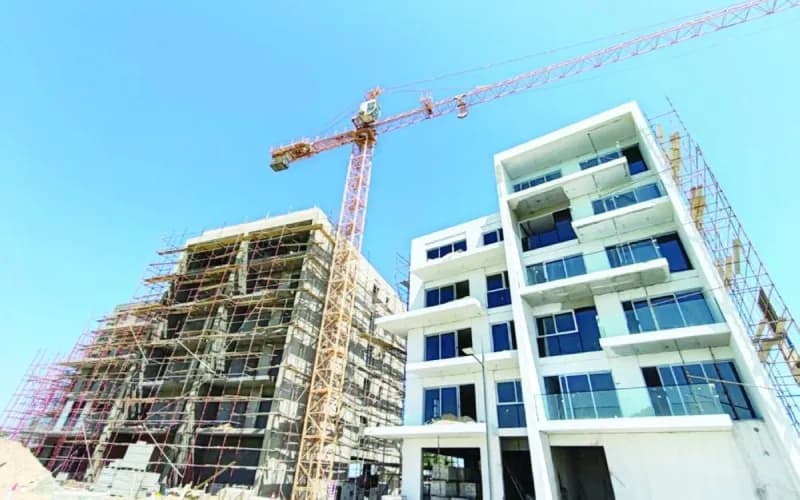
Dubai ranked 68th globally and Abu Dhabi 69th in the International Construction Costs Index 2026, published by global consultancy Arcadis, in a classification covering 100 cities worldwide. The result places both cities in the least expensive third for building construction compared with other major global urban centres.
The report bases its findings on a comparison of construction costs between cities, using Amsterdam as the index benchmark, and calculating project execution prices against unified standards encompassing labour, materials, equipment, and local market conditions, enabling direct comparison across different markets.
Dubai and Abu Dhabi's rankings mean that construction costs in both cities are lower than in roughly two-thirds of the cities covered by the classification. Major European and American cities topped the list of the most expensive markets: Geneva came first, followed by London in second, Zurich in third, Munich in fourth, Copenhagen in fifth, New York in sixth, San Francisco in seventh, Dublin in eighth, Bristol in ninth, and Philadelphia in tenth.
The report noted that the relatively lower construction costs in the United Arab Emirates reinforce the local market's competitiveness in attracting real estate and industrial investment and infrastructure projects, at a time when many global markets face pressure from rising financing, energy, and raw material costs.
The report explained that the construction cost index is based on comparing the cost of erecting buildings of similar technical specifications and quality across different cities, with standardised assumptions regarding design, material type, and finishing level, so that results reflect genuine differences in execution costs between global markets.
In a separate classification for highly technical buildings — such as data centres — Dubai also featured among the group of cities with moderate costs globally, while Zurich, London, and Munich topped the list of the most expensive markets for this category of projects, which relies heavily on electrical and mechanical systems and advanced technologies.
The report forecast that construction price inflation in Abu Dhabi would range between 3.5% and 4.5% during 2026, a figure in line with projections for 2025, amid continued strong activity in the construction sector, though it remains within stable levels compared with many global markets that face greater volatility in execution costs.
The report considered that the global construction sector is passing through a phase characterised by growing geopolitical and economic pressures, noting that the recent war in the region, and the accompanying disruptions to energy flows through the Strait of Hormuz, have raised risks associated with rising oil and gas prices — a factor that is reflected in the costs of construction materials, transport, and energy, and is pushing up inflation rates in the sector.
It added that a sustained rise in energy prices could lead to a tangible increase in project execution costs, particularly since industries such as cement, steel, aluminium, and glass are heavily energy-dependent, in addition to higher operating costs for heavy equipment and logistics.
Despite these challenges, the report affirmed that global demand for data centre projects and energy infrastructure, alongside investment in advanced manufacturing, semiconductors, and artificial intelligence, will remain among the most prominent growth drivers in the construction sector in the years ahead.