
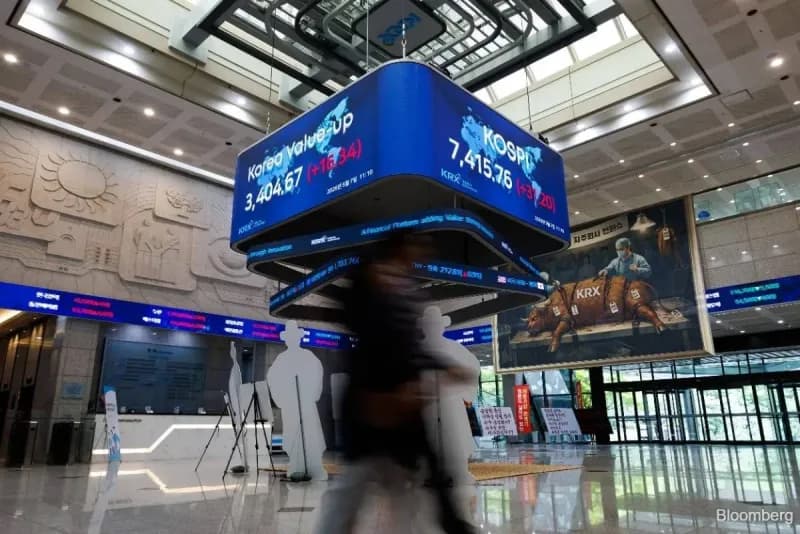
Emerging market equities recorded a historic foreign capital outflow in June, as investors withdrew approximately $46.1 billion from equity portfolios, driven by a decline in technology stocks in South Korea and Taiwan, according to a report issued by the Institute of International Finance.
South Korea accounted for the largest share of the outflow, with foreign investors pulling approximately $30.5 billion from its equities — the largest flight of capital in more than 25 years — while Taiwan recorded outflows of $18.3 billion amid pressure on its technology and semiconductor sector.
Emerging market bonds, by contrast, retained their appeal, attracting $28.3 billion during the month, which softened the overall blow, even as total portfolio flows swung to a net outflow of $17.8 billion.
The institute noted that investors remain willing to finance emerging market economies through debt instruments, but have grown more cautious about equity investment amid elevated valuation risks and uncertainty over corporate earnings.
Emerging markets in Asia accounted for approximately $27 billion of total outflows, while Chinese equities saw $14 billion leave after recording inflows of $8.1 billion in May.
The report cautioned that tightening US monetary policy, volatile oil prices, rising financing costs, and an unclear outlook for the Chinese economy could intensify pressure on emerging markets.
Despite the equity sell-off, the report affirmed that emerging markets continue to attract capital overall, thanks to robust debt inflows, with sovereign bond issuance in the first half reaching approximately $170 billion — the strongest first-half performance in recent years.