
Global financial markets continued their positive performance, supported by a rebound in technology and semiconductor stocks, falling oil prices, and a reduction in geopolitical tensions, as investors awaited the start of the second-quarter earnings season and the Federal Reserve meeting minutes — two of the most influential factors expected to shape market direction in the period ahead.
Trump Accounts
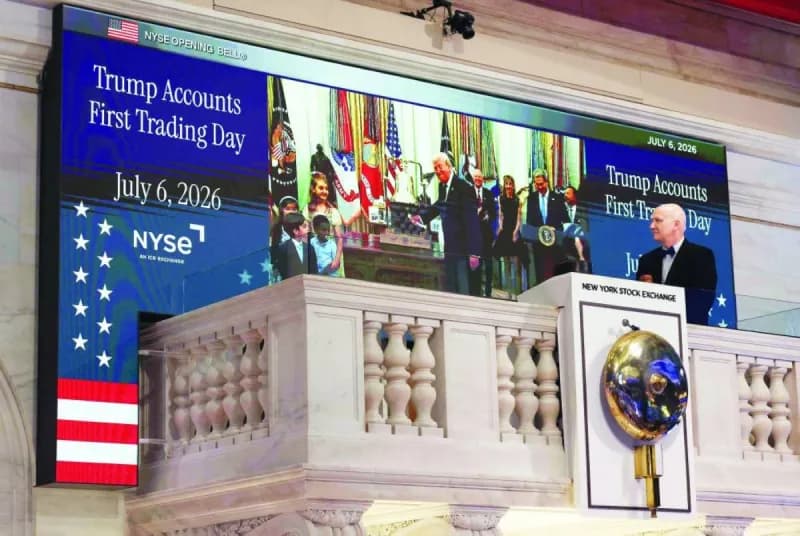
US President Donald Trump on Monday rang the opening bells of the New York Stock Exchange and Nasdaq simultaneously from the Oval Office at the White House, in a symbolic and unprecedented move to mark the official launch of the government-directed children's investment programme known as "Trump Accounts".
Trump announced that the US government had deposited an initial contribution of $1,000 into more than 500,000 Trump Accounts investment plans designated for children, as part of the first funding tranche under the new savings and investment programme.
The programme targets American children born between 2025 and 2028, with the government depositing $1,000 into an investment account for each eligible child. The funds are to be invested in low-cost index funds with the aim of achieving long-term growth, according to Reuters.
Trump made the announcement during the opening bell ceremony for both the New York Stock Exchange and Nasdaq, conducted from the Oval Office at the White House, to celebrate the programme's launch.
Supporters of the programme say it aims to promote financial literacy and encourage long-term investment among American children, while critics argue that lower-income families may struggle to make additional contributions to these accounts, potentially limiting their full benefit from the programme.
US stocks
The S&P 500 and Nasdaq rose on Monday as chip stocks rebounded, with Broadcom advancing after extending its partnership with Apple, while investors looked ahead to the start of the second-quarter earnings season.
The Dow Jones briefly hit a new intraday record before pulling back. The large-cap index had closed at a record high on Thursday.
Broadcom shares rose 4% after the chipmaker agreed with Apple to extend their agreement until 2031 to develop and supply a range of custom-designed chips.
The information technology sector of the S&P 500 rose 1.9%, while the Philadelphia Semiconductor Index gained 3.8%, recovering after two consecutive sessions of losses.
South Korean chipmaker SK Hynix is scheduled to begin trading on Nasdaq later this week.
On the economic data front, the Institute for Supply Management reported that the non-manufacturing purchasing managers' index edged down slightly to 54.0 last month, in line with expectations.
At 12:17 p.m. as of 8:00 a.m. ET, the Dow Jones Industrial Average fell 58.93 points, or 0.11%, to 52,841.14, while the S&P 500 rose 52.99 points, or 0.71%, to 7,536.23, and the Nasdaq Composite climbed 361.98 points, or 1.40%, to 26,194.77.
All three major indices rose about 2% each last week, despite continued volatility in semiconductor stocks, which had been the primary driver of the market's gains this year.
Markets viewed recent strength in healthcare, industrials, and financial services as a sign that the rally may be broadening beyond chips and artificial intelligence.
"The everything trade is still alive. I think the sectors that were almost on the brink during the Iran war will continue to outperform and attract more bids," said Thomas Hayes, chairman of Great Hill Capital.
As the pace of second-quarter earnings announcements picks up later this month, results will provide a new test for markets. Delta Air Lines and PepsiCo are among those expected to report later this week.
Microsoft shares fell 1.6% after the company announced it was cutting approximately 2.1% of its workforce, or around 4,800 jobs.
"What the market is saying is that Microsoft cannot afford all its capital expenditures and there is no clear return on invested capital yet. So layoffs instead of rationalising capex is seen as a negative," Hayes added.
Investors slightly pared back their bets on a US interest rate hike. Last week's Federal Reserve jobs report came in weaker than expected, which could push any rate hike further into the year.
Traders now see a 23% probability of a 25 basis point rate hike at the central bank's meeting scheduled for July 29, down from about 30% a week ago, according to the CME Group's FedWatch tool.
Hawkish expectations rose after last month's Federal Reserve meeting, the first under new Chair Kevin Warsh. The meeting minutes are due on Wednesday.
Federal Reserve Governor Christopher Waller said on Monday that forward guidance can be a "valuable tool" that speeds up the impact of monetary policy under the right conditions, but can become problematic when applied inflexibly.
O'Reilly Automotive shares fell 6.5%. Bloomberg News reported on Thursday that the auto parts retailer had submitted a cash offer to acquire Genuine Parts, whose shares fell 3.5%.
SpaceX shares fell 0.3%. Elon Musk's rockets and artificial intelligence giant is scheduled to join the Nasdaq 100, which is primarily composed of technology companies, on Tuesday.
Advancing stocks outnumbered decliners by a ratio of 1.57 to 1 on the New York Stock Exchange and 1.52 to 1 on Nasdaq.
Neither the S&P 500 nor the Nasdaq Composite registered any new 52-week highs or lows. (Reporting by Ragini Mathur and Avinash B in Bengaluru; editing by Pooja Desai)
European stocks
Europe's benchmark Stoxx 600 index retreated after hitting a record high on Monday, as investors took profits following a strong rally, while a $7.34 billion takeover bid boosted easyJet's shares.
The European index closed down 0.35% at 650.5 points. It had earlier reached an all-time peak of 654.44, after posting its best weekly performance since mid-May.
With declines of 1.81% and 1.80% respectively, utilities and healthcare were the biggest drags on the index. Food and beverage stocks also fell 1.67%.
Germany's DAX, however, bucked the broader regional weakness, edging up 0.15% to set a record high, notching gains for a fifth consecutive session.
Industrial orders in the eurozone's largest economy rose more than expected in May.
"Investors have largely overlooked German equities in the second quarter. We expect that to change," Deutsche Bank analysts led by head of European equity and multi-asset strategy Maximilian Uleer wrote in a note.
"Mid-cap German companies, particularly those exposed to increased infrastructure spending, will be among the biggest market winners."
Investors are also looking to the earnings season, which could prove decisive for stocks and give them fresh momentum if results come in stronger than expected.
"The upcoming earnings season is supposed to be a test for the AI sector, and it is likely to influence market performance over the coming months," said Mohit Kumar, economist at Jefferies.
He added: "There have been concerns about overcapacity and whether capital expenditure on AI will deliver the expected returns. We are optimistic about the earnings season. Capex remains strong, and as long as the money keeps flowing, AI-related sectors are expected to enjoy strong support."
Data released on Monday showed eurozone retail sales rose 1.6% year-on-year in May, in line with estimates.
Among the biggest gainers in the region, easyJet's shares surged 9.28% after the British low-cost airline provisionally agreed to an improved takeover offer from US investment firm Castle Lake, valuing the company at up to £5.5 billion ($7.34 billion).
Defence stocks were among the most profitable sectors, rising 1.33%, amid the continuing war in Ukraine with no signs of abating. Investors bought into defence stocks driven by expectations that rising geopolitical tensions will continue to support the sector.
Exail shares rose 2.12% after Thales reached a deal to acquire the Georgy family's controlling stake in the drone technology company.
Airbus shares rose 1.58%. Industry sources said the planemaker had set an internal target of delivering 900 aircraft this year after delivering more than 89 planes in June, while keeping its official full-year guidance of 870 deliveries unchanged.
Ferrari shares rose 2.22% after the luxury racing car manufacturer launched a limited-edition model with a 12-cylinder engine and manual transmission.
JPMorgan upgraded its rating on Greece from "neutral" to "overweight", citing expected cash inflows of approximately $1 billion from the inclusion of certain Greek stocks in the Stoxx 600 later this year.
Asian stocks
Japan's broader Topix index rose for a sixth consecutive session on Monday, as falling oil prices and positive momentum in global markets boosted investor sentiment. The Topix climbed 0.50% to close at 4,084.74, marking its longest winning streak since August 2025. The technology-heavy Nikkei 225 benchmark closed unchanged at 69,737.69.
This comes as investors await signals on central bank policy, with the Federal Reserve appearing to lean toward monetary tightening under Chair Kevin Warsh, while the Bank of Japan is also expected to continue its policy tightening. Meanwhile, increased oil production expectations and the reopening of the Strait of Hormuz contributed to a sense of relief in markets.
The yen resumed its downward trend, keeping traders on alert for potential intervention by Tokyo authorities.
"Volatility in AI and semiconductor stocks will continue to influence the direction of the Nikkei 225, whether up or down," said Maki Sawada, equity strategist at Nomura Securities.
Shipping, automobile, and machinery sectors led broader market gains. Toyota Motor shares rose 3.36% and Mitsubishi Heavy Industries surged 8.39%. Technology supply chain companies led losses on the Nikkei. The biggest losers were Taiyo Yuden, which fell 10.58%, followed by Ibiden, which dropped 8.37%, and Murata Manufacturing, which declined 7.49%. Of the 225 stocks on the Nikkei, 177 advanced and 48 declined.
South Korea's Kospi index fell 0.5% to 8,051.33.
In contrast, Hong Kong's Hang Seng Index rose 1.1% to 23,616.32, while China's Shanghai Composite Index fell less than 0.1% to 4,041.24.
Australia's S&P/ASX 200 fell 0.2% to 8,831.
Oil prices declined on Monday morning, with Brent crude, the international benchmark, falling 40 cents to $71.72 per barrel, and the US benchmark West Texas Intermediate dropping 29 cents to $68.40 per barrel.
In currency markets, the US dollar rose against the Japanese yen to 162.29 yen from 161.32, while the euro slipped to $1.1419 from $1.1437.