
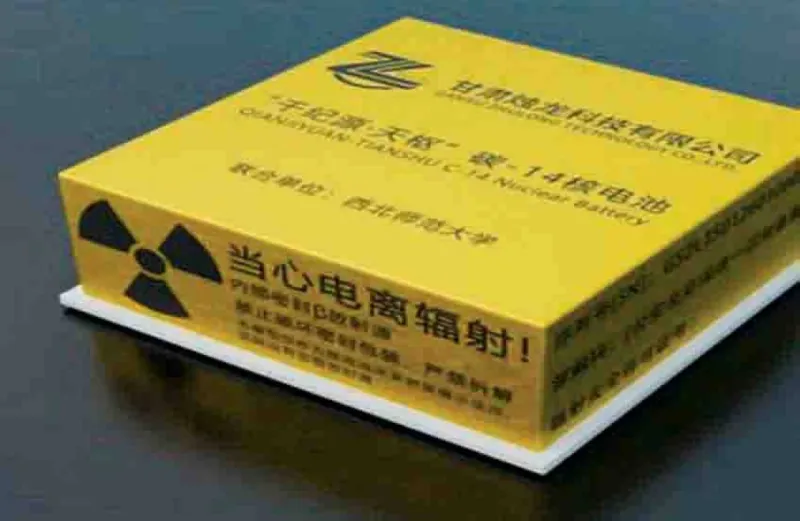
Chinese scientists have succeeded in developing a nuclear battery with an estimated lifespan of thousands of years. According to Russia Today, the battery was developed through a collaboration between researchers from Northwest Normal University and experts from Gansu Zhulong Technology, and it relies on the carbon-14 isotope and a converter made from silicon carbide (SiC).
Nuclear batteries, or radioisotope batteries, generate electricity from the energy released by the decay of radioactive isotopes. Thanks to the long half-lives of the isotopes used, these batteries can operate for centuries, giving them a significant advantage over conventional chemical batteries. Similar batteries have already been used in space missions, including the Voyager probes, the Curiosity rover, and China's Chang'e-3 and Chang'e-4 lunar probes.
The team leader from Northwest Normal University, Su Maojin, explained that the operating principle of this battery differs from conventional nuclear batteries. Rather than converting heat into electricity, it relies on the direct effect of beta particles on a semiconductor made from silicon carbide, a principle closely resembling the mechanism of solar panels, except that the energy source here is nuclear radiation — enabling a roughly 15-fold increase in volumetric energy density.