
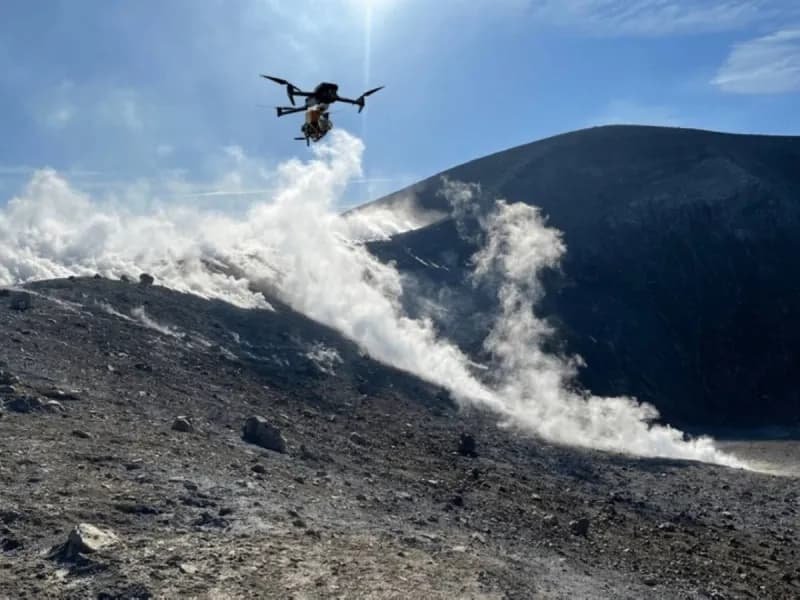
On the small volcanic island of Vulcano, north of the Italian island of Sicily, German researchers are testing a new system that uses a laser-equipped drone to measure volcanic gases, with the aim of developing more accurate methods for predicting volcanic eruptions.
The drone flies above the rim of the volcano's crater, which rises to approximately 400 metres, collecting data on gas concentrations within a matter of minutes. A ground-based sensor fires a laser beam through the volcanic emissions, which then reflects back off the drone; the data are subsequently used to produce detailed maps of gas distribution.
This is the first test of its kind for a team from the University of Munich, which will later move on to Mount Etna in Sicily. A separate team from the University of Mainz is also working on using sensors mounted on drones to measure chemical compounds and particles in the air. The scientists explained that monitoring gases — particularly carbon dioxide and sulphur dioxide — helps to better understand volcanic activity, as their composition may change before an eruption occurs. The researchers affirm that these technologies will contribute to the development of safer and more precise tools for volcanic monitoring, following years in which drones have become an increasingly important instrument in the field.