
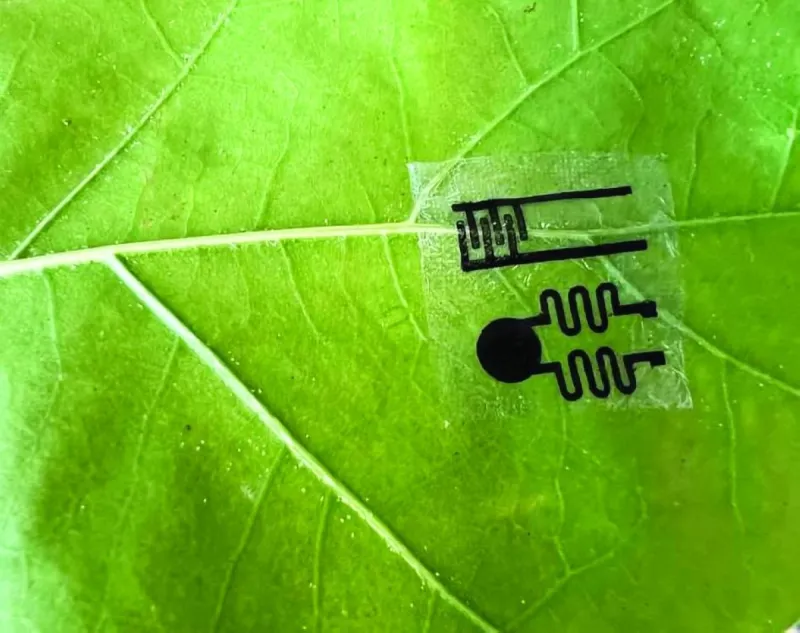
Researchers at Tufts University have developed tiny tattoo-like sensors that function as wearable devices for plants, with the aim of detecting signs of stress before visible damage appears on crops, according to a study published in a leading journal.
The system operates via two sensors: the first is attached to leaves to monitor temperature, humidity, and water evaporation rates, while the second wraps around the stem like a rubber band to track growth rates. The advanced system operates without external batteries, drawing its power directly from the plant's moisture.
Experiments conducted on pepper plants demonstrated that these miniature devices successfully distinguished with precision between healthy plants and those suffering from water deficit or elevated salinity, paving the way for the creation of smart, sustainable monitoring networks within farms.
These innovations represent a qualitative leap in the field, embodying early-warning systems that show how a plant is responding in real time, before any visible signs appear.
The sensors can also be expanded to track other important indicators of plant health, such as levels of essential nutrients and plant hormones — which serve as early signals for the growth of roots, leaves, stems, and fruit — as well as responses to pathogens.