
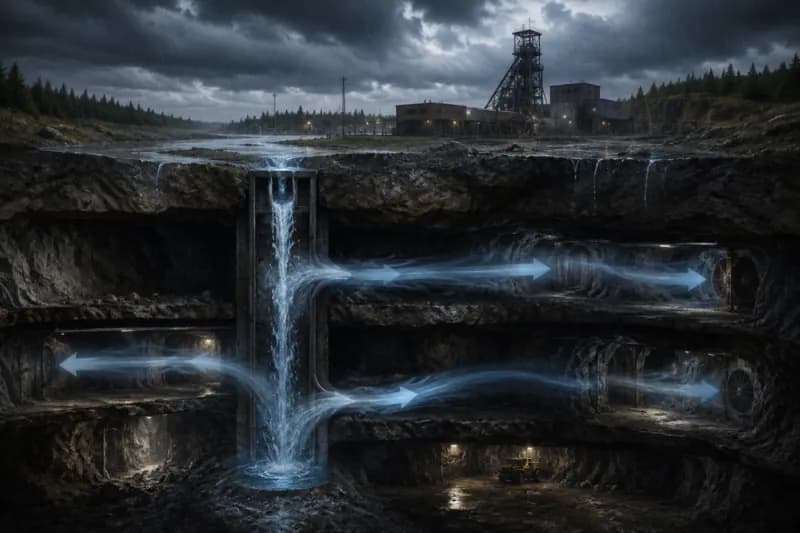
The effects of rain may appear to be limited to the surface of the earth, but scientists have discovered that rainfall is also capable of producing unexpected changes deep underground. During heavy downpours, large volumes of water flowing into mines and deep tunnels push air through ventilation networks, causing airflow to slow or even temporarily reverse. The phenomenon baffled engineers for years before they were finally able to uncover the secret behind it.
The story began inside the Sanford Underground Research Facility (SURF) in South Dakota, where engineers noticed during rainstorms that the ventilation system was not functioning normally — airflow would slow suddenly and sometimes reverse direction entirely, a phenomenon that no one could initially explain.
As the phenomenon continued to recur, a team of engineers began collecting and analysing data, until modern sensors led them to an unexpected discovery. It emerged that rainwater seeping into one of the mine's shafts and descending to depth acts like a giant air piston, pushing enormous volumes of air through the tunnel network as it falls, causing a temporary change in ventilation movement.
Mining engineer Jason Knotek, one of the study's participants, said the team had observed for years that the fans behaved strangely during heavy rain, but the cause remained unknown until more advanced sensors were installed, enabling them to monitor airflow with precision.
Experiments carried out by a science teacher and his students at a secondary school also helped detect unexpected changes in air movement while testing the drainage system, providing the first real evidence of the relationship between falling water and air inside the mine.
Researchers then developed a model based on the principles of fluid dynamics, drawing on studies previously conducted on large sewage networks, and found that the results closely matched actual measurements taken inside the facility.
Knotek explained that what astonished the team most was that the mere fall of water inside the shaft was capable of moving huge volumes of air — a result he described as seeming almost unbelievable before it was proven in practice.
The importance of this discovery is not limited to explaining a mysterious scientific phenomenon; it extends to enhancing safety inside underground facilities. This knowledge can be used to predict ventilation changes during heavy rain or in emergency situations — such as fires, when large quantities of water are pumped into mines — according to the website Daily Galaxy.
Researchers believe that understanding this relationship between water and air will in future help in designing more efficient and safer ventilation systems, protecting workers in mines and deep facilities and reducing the risks arising from unexpected changes in airflow.