
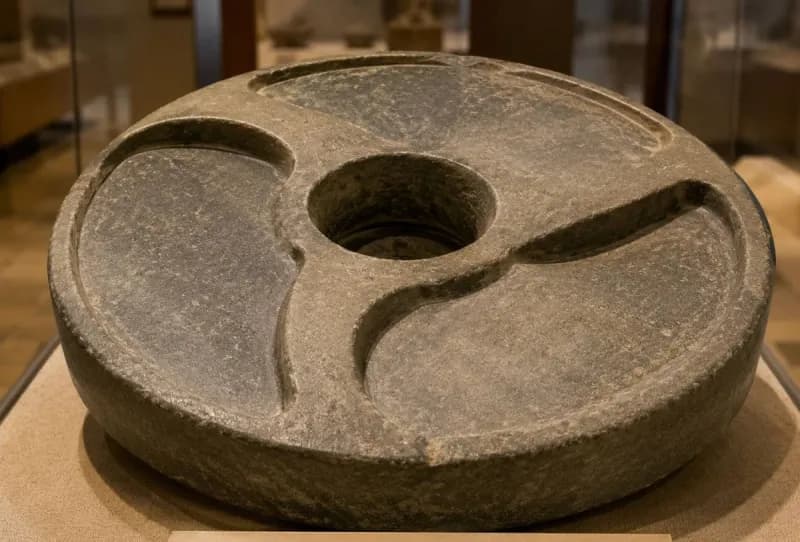
Deep within one of Egypt's oldest cemeteries — specifically inside a tomb more than 5,000 years old in the Saqqara region — archaeologists have discovered a mysterious stone object that continues to spark debate to this day. Known as the "Sabu Disc", the artefact attracted attention from the moment it was found, not only because of its great age but because of its unusual shape, which bears a striking resemblance to a modern car hubcap or a mechanical fan.
The disc was discovered in 1936 during excavations led by British Egyptologist Walter Emery inside the tomb of a senior official of the First Dynasty named Sabu, who lived between 3100 and 2900 BC. It was found broken into pieces, which were subsequently reassembled with care. Today it is preserved in the Egyptian Museum in Cairo as one of the most puzzling objects in the history of Egyptian antiquities.
What makes the Sabu Disc so intriguing is its unconventional design: it consists of a circular stone vessel approximately 61 centimetres in diameter and around 10 centimetres in height, with three curved lobes extending from the rim toward a central opening. This gives it a strikingly modern appearance that has led some to compare it to a steering wheel or a component of an advanced machine, opening the door to dozens of unorthodox interpretations over the years.
This strange form made the object the focus of wide debate among researchers and enthusiasts alike, with multiple theories emerging about its function. Some interpretations went so far as to suggest it may have been part of a mechanical device or even an unknown advanced technology, while others linked it to more fantastical explanations such as spacecraft or ancient turbines — hypotheses that have received no scientific support.
The majority of archaeologists, however, lean toward a simpler and more realistic explanation. Studies suggest that the Sabu Disc was nothing more than a luxury stone vessel, most likely used to store food or oils, or perhaps for ritual purposes related to burial and offerings. This hypothesis is supported by the nature of the material from which the disc is made — a relatively brittle stone unsuited to intensive everyday use, according to the website Live Science.
Furthermore, its presence inside Sabu's tomb alongside other funerary items — such as pottery and stone vessels and animal remains — reinforces the idea that it was part of the burial goods presented to the deceased for his journey to the afterlife, rather than a technological implement as some believe.
Despite the many decades since its discovery, the Sabu Disc retains its fascination as one of ancient Egypt's most captivating archaeological mysteries — seen by some as a symbolic work of art, by others as an enigmatic object ahead of its time — standing as testimony to the complexity of ancient Egyptian civilisation and its capacity to produce forms that continue to confound the mind to this day.