
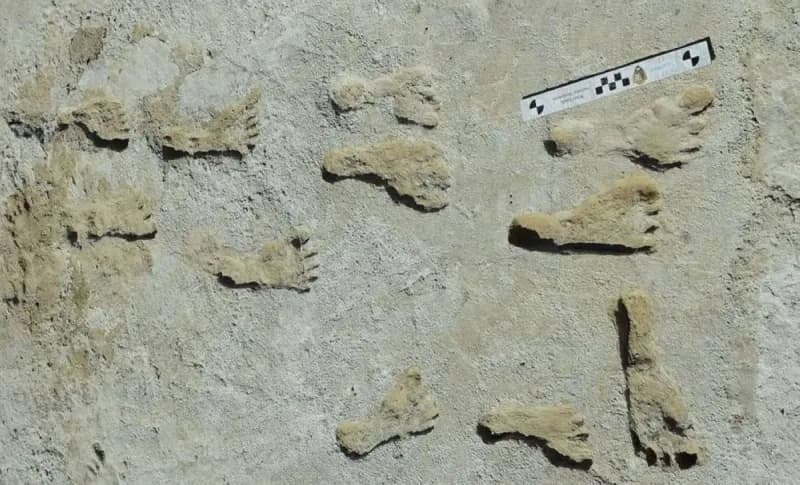
A new scientific study supports earlier controversial findings about the presence of humans in North America far earlier than previously believed, following the discovery of new evidence at the White Sands site in the US state of New Mexico. The evidence suggests that human footprints date back roughly 23,000 years, reigniting a wide debate in archaeological circles about the history of human settlement on the continent.
According to the study, published in the journal Science Advances, a team of researchers analysed organic material preserved within layers of ancient mud at the site — an approach that differs from earlier studies, which relied on dating seeds and pollen grains found in the same geological deposits. The results of the new analysis closely matched previous findings, with dates ranging from approximately 20,700 to 22,400 years ago, reinforcing the hypothesis that the footprints genuinely date to the period between 23,000 and 21,000 years ago.
White Sands today is a desert region distinguished by its sweeping white gypsum dunes, but thousands of years ago it was an entirely different environment — a rich ecosystem containing lakes and waterways. As those bodies of water dried up over time, the footprints were buried beneath layers of gypsum sediment, preserving them in an exceptional state to the present day.
The researchers note that the strength of the study lies not only in the findings themselves but in the variety of dating methods employed. Three different materials were used to determine age: seeds, pollen grains, and the ancient mud itself, with analyses carried out at several independent laboratories. These processes yielded approximately 55 closely consistent dating results, which scientists considered strong evidence of the accuracy of the age estimates and confirmation that they were not merely coincidental.
Archaeologist and geologist Vance Holliday, one of the project's leading researchers, said the data show "unusual consistency," adding that it is illogical for all these different methods to produce identical results if they were wrong. He affirmed that the accumulation of evidence from multiple sources greatly reinforces the validity of the conclusions regarding the age of the footprints.
These findings carry particular significance because they challenge the traditional hypothesis linking the earliest human presence in North America to the Clovis culture, which dates back only around 13,000 years. If the White Sands footprints are accurate, it means humans were present on the continent some 10,000 years earlier than that, compelling a rethink of the sequence of human migrations into the Americas.
Nevertheless, the discovery continues to raise important scientific questions. Most prominent among these is the absence of stone tools or the remains of habitation sites near the footprints. Some researchers consider this absence a puzzle requiring explanation, while the study team believes the nature of the evidence may account for it: what was found may represent no more than brief moments of human movement through an open area, rather than a permanent place of residence.
Holliday maintains that hunters and gatherers of that era may not have left behind obvious tools or refuse, particularly in an environment where resources were scarce and distances between sources of raw materials were great. He also notes that expecting to find a complete camp alongside footprints thousands of years old may not be scientifically reasonable.