
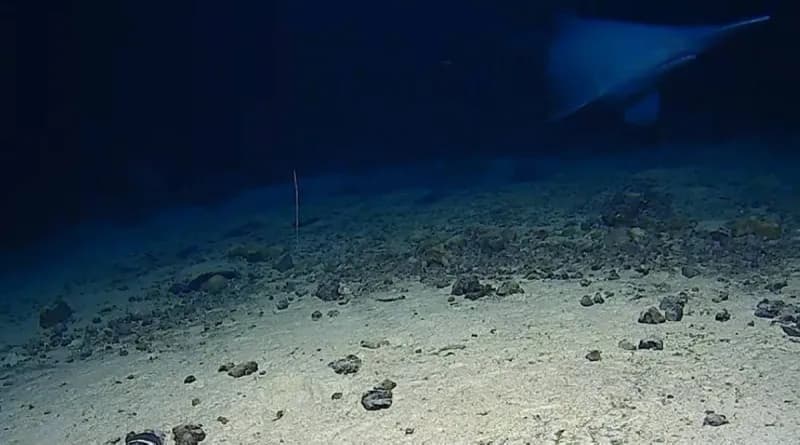
Scientists have succeeded in filming the goblin shark for the first time in its natural habitat, an achievement that gives researchers an unprecedented look at one of the most mysterious and fascinating shark species in the deep sea, and changes many of the prevailing ideas about its lifestyle and behaviour.
Although the species was first discovered in 1898 off the coast of Japan, most of what scientists knew about it came from specimens hauled to the surface after being caught or found dead, while live sightings in the deep ocean had remained extremely rare, according to IFLScience.
The goblin shark, known scientifically as Mitsukurina owstoni, inhabits the depths of the Atlantic, Indian and Pacific oceans, where it favours dark environments at depths exceeding 1,000 metres, well beyond the reach of divers and most conventional exploration equipment.
The shark is distinguished by a unique appearance that makes it one of the most bizarre marine creatures, featuring a long, flat snout and jaws capable of thrusting forward at tremendous speed to seize prey.
This system is considered one of the fastest predation mechanisms among sharks, with the jaws launching at speeds of up to approximately 3.1 metres per second and extending to a distance equivalent to about 9% of the shark's body length, allowing it to catch prey that would otherwise escape.
The first field documentation of the species came during a scientific expedition aboard the research vessel Nautilus in 2019, when a remotely operated vehicle known as Hercules captured footage of an adult male at a depth of 1,237 metres near Jarvis Island in the central Pacific Ocean. Researchers estimated the shark's length at approximately 3.43 metres and judged it to be more than 50 years old.
The second sighting came in 2024 on the slopes of the Tonga Trench in the western Pacific Ocean, where scientists documented another individual at a depth far greater than any previously recorded for the species, extending its known range by an additional 697 metres.
Preliminary analyses suggest the second specimen was most likely female, as no male reproductive fins were visible.
Researchers believe the significance of these observations extends beyond their being the first footage of the species in its natural habitat; they also provide direct information about its preferred habitats and deep-sea behaviour, which had been difficult to study relying solely on surface-hauled specimens.
The findings also confirm that the goblin shark uses a variety of habitats in the Pacific Ocean, including seamounts and slopes near oceanic trenches, suggesting a wider distribution than previously believed.
Researchers stress that this information will be of great importance for efforts to protect deep-sea species, particularly as human activities in the deep ocean — such as mining and fishing — increase, potentially threatening slow-growing and slow-reproducing creatures such as the goblin shark.
The team added that determining the true geographical range and depth at which the species lives is an essential step towards understanding its ecology and drawing up more effective conservation plans, especially since many deep-sea creatures remain unknown in terms of their numbers and behaviour.
The study's findings were published in the Journal of Fish Biology, presenting the first field documentation of the goblin shark in its natural environment and opening a new window for scientists to study one of the deep sea's most enigmatic predators.