
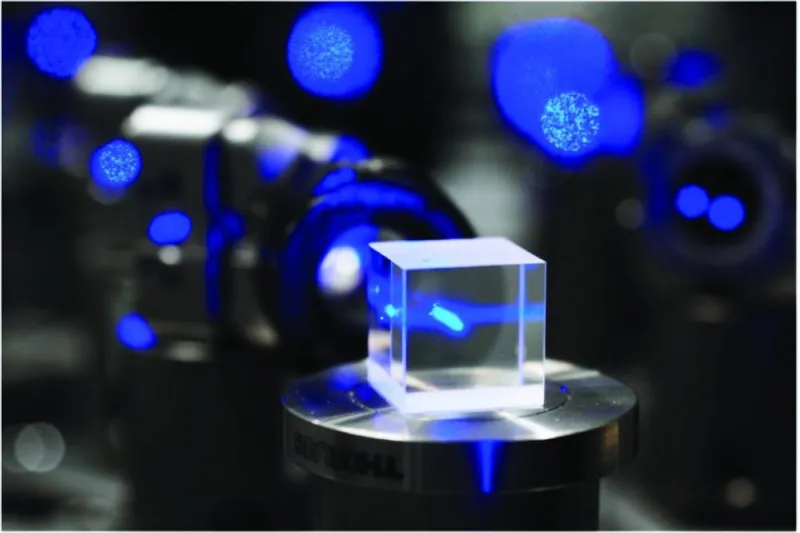
An international team of physicists has succeeded in creating the world's first fully integrated quantum detector for gravitational waves and dark matter, based on the principle of differential atom interferometry, which allows noise levels to be reduced during measurements, according to an announcement by the press service of Imperial College London.
Professor Olivier Buchmueller said: "We have taken a major step towards developing large-scale quantum sensors to solve fundamental physics problems.
We were able to demonstrate the viability of atom interferometry under the most realistic measurement conditions, opening the way for the establishment of projects such as the MAGIS detector at the Fermi laboratory."
According to RT, atom interferometry measurements, as Professor Buchmueller and his colleagues explained, are measuring instruments that use the quantum properties of atoms to perform ultra-precise measurements of changes in the position of particles in a vacuum under the influence of various forces.
These devices rely on optical traps that capture clouds containing individual atoms of caesium, sodium, or strontium, isolating them from the surrounding environment.
During measurements, scientists manipulate the quantum properties of these atomic clouds so that they begin to behave not as particles but as wave-like objects. By tracking the interactions of these wave-like objects with laser beams, it is possible to measure gravitational force with precision and determine other fundamental physical constants.