
In 2023, everyone was caught off guard when Disney CEO Bob Iger announced a fifth instalment in the Toy Story franchise. The news sparked joy at the return of a childhood favourite, but also anxiety that the series was about to fall victim to what filmmakers and content creators call "stretching" — milking a name purely for profit at a time when Disney was going through a critical financial period and its films had suffered a major blow at both the American and global box office.
What audiences wondered most was what new challenge the toys would face. In the third film, Andy handed his toys over to Bonnie, who took care of Woody, Buzz, and Jessie. The fourth film then set Woody on a different path, as he chose to embark on his own journey and separate from his fellow toys. Then, in 2024, the promotional campaign began, revealing that the new enemy of traditional toys would be smart devices.
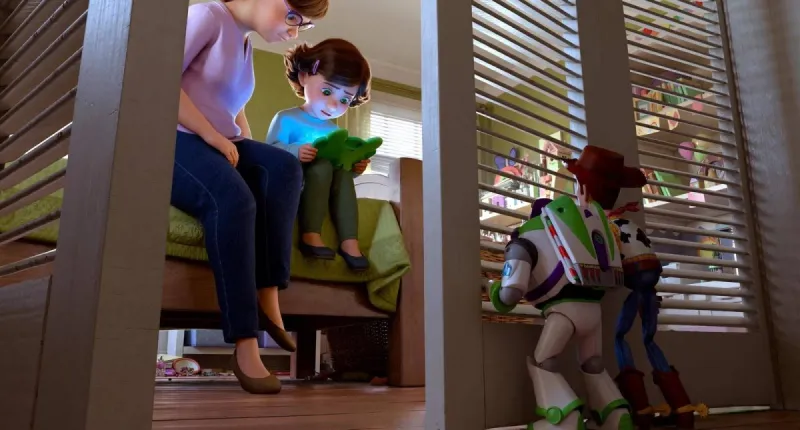
Watching the film, the choice of smart devices as the antagonist proves highly apt. From the outset, the film shows Bonnie struggling to make friends — the result of holding on to her toys at a time when the current generation has turned to smart devices and their apps. Her solution is to acquire a device called the Lilypad, through which she can win friends and show how well she fits in with the new generation. At the same time, the device becomes a source of deep anxiety for the toys — Jessie in particular — that their owner will abandon them forever.
Through this story, the film sounds a clear alarm. It suggests that excessive reliance on smart devices may deprive children of certain aspects of traditional childhood, compounded by the absence of parental supervision and culminating in cyberbullying, which pushes Bonnie to give up her toys against her will simply to be liked and accepted by her new friends.
The film also addresses the weakening of human connection and social skills, which have declined sharply among the new generation. Young people now live on isolated islands, far removed from weekend get-togethers, preferring to connect remotely through devices — with all the serious risks that entails.
But there is also a subtext worth reading. Traditional toys and the companies that make them have fallen sharply as smart devices have come to dominate. Mattel suffered a massive 30% drop in its share price last February due to weak profit forecasts tied to a sluggish traditional toy market, while Hasbro chose to focus on the digital sector, which has served as a lifeline, delivering historic gains of 45% last year.
The film can also be read as an indirect message reminding audiences of the value of traditional toys — something that conveniently serves Disney's own commercial interests at the same time.
On the artistic level, the film is well worth watching. The franchise has lost none of its enchanting magic and avoids the trap of repetition. After years in the series, Jessie finally gets her moment as the undisputed star of the film — a role she embraces with a performance that proved its worth with the children I watched it alongside, as she demonstrated a clear ability to steal the spotlight from the franchise's core heroes, Woody and Buzz.
Although the film raises an important issue about smart-device addiction and its effect on children, it sometimes oversimplifies the problem by portraying technology as the principal villain in the lives of the new generation, when the reality is considerably more complex. The problem lies not in the devices themselves, but in how they are used and in the absence of balance and parental supervision.
For most of its runtime, the film tilts toward the perspective of traditional toys, before offering a more balanced vision at the end that affirms the possibility of coexistence between technology and human relationships.
From another angle, the film can be seen as a reflection of the toy industry's own anxieties. While it champions the importance of traditional play and direct human interaction, it simultaneously serves — indirectly — the companies that depend on selling physical toys in a market moving rapidly toward digital content, apps, and electronic games.
It can therefore be said that the film succeeds in sparking an important conversation about childhood in the digital age. Through the conflict between traditional toys and smart devices, it raises questions about technology's impact on children and their social relationships. Although it begins by portraying smart devices as a threat to the world of traditional toys, it ends with a more balanced message: the problem is not technology itself, but the way it is used. Ultimately, the film reminds us that friendship, imagination, memories, and human connection remain things no screen can ever fully replace.